"Last Song Playing©"
Lyrics by M. S. McKenzie (Unless Otherwise Noted) | Music Performed by Songs Across America or American Storyteller Music, All Songs Are Protected by Copyright
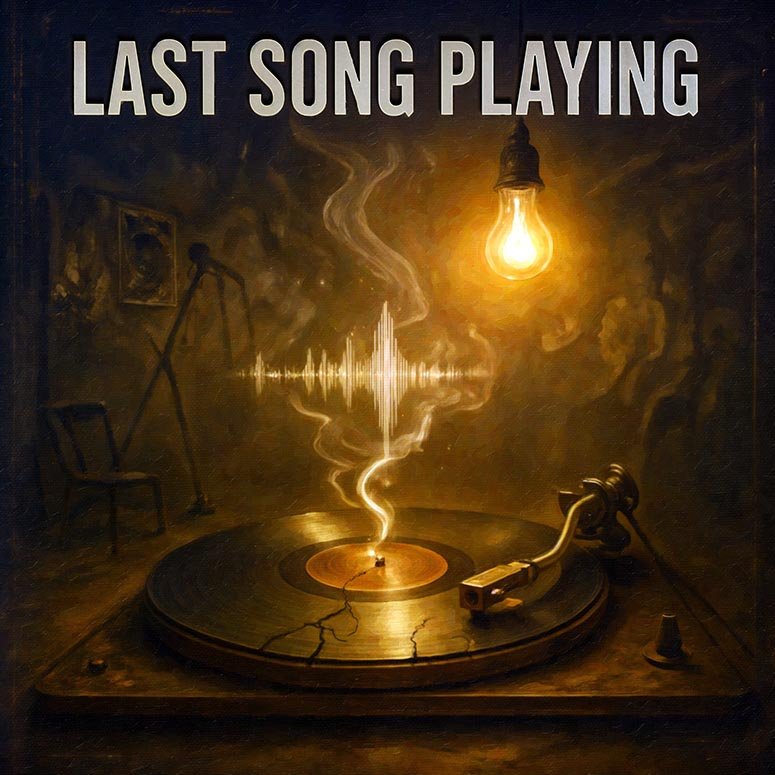
"Last Song Playing"
The story behind the song is a last song playing on broken air, in a room where the lights flicker and the speakers yawn and everything feels like it's coming apart. I wanted it to sound like the end of a long night, the static humming with a bite, a twisted rhythm crawling along, echoes screaming through the cracks. It's raw on purpose. This one isn't polished, it's the sound of holding on when the room is falling down around you.
There's a defiance running under all that chaos. Vinyl scars, a rebel tune, a warrior dawn under a paper moon, the walls breathing sweat as we lose control. I framed it with a piano concerto in C minor at the front and back because I liked the collision, something formal and beautiful bracketing something wild and barely contained. The chaos feeds what the silence stole.
But the line that matters most is the last one. "The last song ends, but we still stand." For all the wreckage in the song, that's what it's really about, surviving the final song, letting the night fold us in its hollow hands and carry the melody off to foreign lands, and still being on your feet when it's over. It's a song about endings that refuses to be defeated by one.
Raw, gritty rock bracketed by a C-minor piano concerto intro and outro.
Defiance and survival, chaos and control, endings and endurance, and raw catharsis.
Primary Subject:
A last song playing in a room coming apart, and the defiant refusal to be defeated by the end.
Mood:
Gritty, defiant, chaotic, and unbroken.
Even as everything falls apart and the last song crawls across broken air, defiance and survival win out. The song ends, but we still stand.
[Intro: Instrumental-Piano Concerto in C Minor]
[Verse 1]
The static hum's got a bite tonight
Dim lights flicker like a closing fight
Feeling the pulse as the speakers yawn
This ain't forever but it won't be gone
[Chorus]
It's the last song playing on the broken air
Twisted rhythm crawls like it doesn't care
Echoes screaming through the cracks we bare
It's the last song playing we're barely there
[Verse 2]
Vinyl scars scratch the rebel tune
Warrior dawn in a paper moon
The walls breathe sweat as we lose control
The chaos feeds what the silence stole
[Bridge]
Spin it backward let it twist and burn
Fragile grooves where the secrets turn
Every crack a whisper every drop a scream
Feel the edge cut sharp through the fleeting dream
[Chorus]
It's the last song playing on the broken air
Twisted rhythm crawls like it doesn't care
Echoes screaming through the cracks we bare
It's the last song playing we're barely there
[Outro]
Let the night fold us in its hollow hands
Take the melody to foreign lands
Tie the silence to the fiery strand
The last song ends but we still stand
[Outro: Instrumental-Piano Concerto in C Minor]
"Last Song Playing" is a dark, volatile song about music surviving at the edge of collapse. Set within a decaying atmosphere of radio static, flickering lights, damaged speakers, scarred vinyl, sweating walls, and fractured sound, the lyrics capture the final moments of a performance, a broadcast, a cultural era, or perhaps an entire way of life. The song presents music as wounded but defiant, distorted by time and pressure yet still powerful enough to hold people together when nearly everything else is disappearing.
The title immediately creates a sense of finality. A "last song" suggests an ending that has already begun: the closing number of a concert, the final record played in an abandoned room, the dying transmission of a radio station, or the final expression of a generation refusing to vanish quietly. Yet the word "playing" keeps the moment active. The ending has not arrived completely. The music is still moving through the air, and while it continues, something remains alive.
The instrumental introduction, described as a piano concerto in C minor, establishes an unexpectedly dramatic and classical foundation. C minor is often associated with tension, struggle, gravity, and emotional force, making it well suited to the song's atmosphere. The concerto-style opening can give the composition a sense of grandeur before the distorted imagery of the verses enters. This contrast between formal piano and damaged rock textures suggests beauty trying to survive within chaos.
The piano may also represent an older musical tradition standing beside more rebellious forms such as vinyl-driven rock, punk, grunge, or experimental alternative music. By framing the song with a concerto, the composition connects different eras of music and implies that the struggle to create, resist, and endure transcends genre.
The first verse begins with the hum of static, but the static is given a physical quality: it has "a bite tonight." This transforms background interference into something threatening. The air itself seems electrically charged, as though the equipment, room, and people inside it are approaching a breaking point.
Static traditionally represents failed communication, lost signals, or the space between stations. Here, it suggests a world in which clear messages have become difficult to transmit. The music must fight its way through noise, distortion, and technological decay in order to be heard.
The dim lights flicker "like a closing fight," creating the impression of a venue, studio, basement, or abandoned broadcasting space nearing its final moment. The word "fight" implies that the ending is not peaceful. Something has resisted being shut down, forgotten, or silenced, but its strength is fading.
The flickering lights may resemble a fighter struggling to remain conscious after repeated blows. They flash with brief signs of life before darkness returns. This gives the setting both cinematic tension and emotional vulnerability.
The narrator feels the pulse while the speakers "yawn." The pulse may be the bass rhythm, electrical current, heartbeat of the crowd, or remaining life within the music. In contrast, the yawning speakers seem exhausted. Their cones open and strain as though they have played too loudly and too long.
Personifying the speakers makes the equipment part of the song's exhausted community. The machines are not neutral objects. They have absorbed years of sound, anger, joy, and performance, and now they appear as tired as the people listening.
"This ain't forever but it won't be gone" captures the central paradox of the song. The performance, room, broadcast, or cultural moment cannot continue indefinitely, yet its influence will not disappear completely. Music is temporary while it is being played but permanent in memory, identity, and emotional consequence.
The line also resists the idea that endings erase what came before. The sound may stop, but the experience remains in the bodies and minds of those who heard it. The last song is therefore both an ending and a form of preservation.
The chorus introduces the image of music traveling across "broken air." This phrase suggests damaged radio waves, distorted speakers, fractured communication, and a world no longer functioning properly. The air through which sound must move has itself become unstable.
The last song is not playing through pristine equipment or a peaceful environment. It is forcing itself through damage. That struggle gives the music urgency and makes every note feel hard-won.
The "twisted rhythm" crawling as though it does not care gives the sound an almost animal presence. It does not flow elegantly or march with confidence. It crawls through debris, continuing by instinct. The rhythm appears indifferent to whether anyone approves, understands, or survives.
That indifference can be heard as rebellious. The music does not ask permission to exist. Even distorted and nearly defeated, it continues moving forward according to its own logic.
The echoes screaming through "the cracks we bare" connect the damaged environment with the emotional wounds of the people inside it. The cracks may exist in walls, records, speakers, relationships, identities, or society itself.
The choice of "bare" suggests that these fractures have been exposed. The listeners are no longer hiding their damage. Music travels directly through their weaknesses and turns them into resonating spaces.
The final line of the chorus, "we're barely there," creates a sense of physical and psychological exhaustion. The people may be intoxicated, overwhelmed, grieving, dissociating, or simply pushed beyond endurance. They remain present only through the song.
This makes the music a final anchor. While the listeners are close to disappearing into chaos, the last song gives them something to share. They may be fractured individually, but they occupy the same rhythm for a few remaining minutes.
Verse two shifts toward vinyl and the marks left by repeated use. "Vinyl scars" refers to scratches across a record, but the phrase also suggests wounds accumulated through experience. The record has survived years of needles, handling, dust, and replaying.
Those scars do not completely destroy the music. Instead, they alter it, adding pops, distortion, and imperfections to the sound. The damaged record becomes a metaphor for people whose histories can be heard in the way they now speak, move, create, and respond.
The "rebel tune" associates the music with resistance. It may belong to punk, protest rock, grunge, underground music, or any form of expression created outside approved cultural boundaries. The scratched record carries an older act of defiance into the present.
"Warrior dawn in a paper moon" is a striking surreal image. Dawn usually represents renewal, while a warrior suggests readiness for conflict. Yet the moon is made of paper, implying fragility, artificiality, theatrical scenery, or a reality that may collapse when touched.
The lyric creates a world in which strength and weakness exist simultaneously. A new day may be arriving, but it emerges beneath a false or delicate sky. Hope is present, though it cannot be trusted completely.
The walls breathing sweat intensify the physical environment. The room appears overcrowded, overheated, and alive with pressure. Moisture gathers on surfaces as though the building itself is perspiring along with the crowd.
This image evokes underground clubs, rehearsal rooms, warehouse concerts, basement shows, or any space where music is experienced at close range. There is no distance between performer, listener, heat, sound, and structure.
As control is lost, chaos feeds what silence stole. This line suggests that silence had deprived the people of voice, release, community, or emotional expression. Chaos now restores those things, though in an unstable form.
The song therefore does not portray chaos as purely destructive. Disorder becomes a source of energy because restraint and silence had become unbearable. The crowd needs noise in order to recover something that quietness suppressed.
The bridge invites the listener to spin the record backward and allow it to "twist and burn." Reversing the record suggests searching for hidden messages, revisiting the past, challenging ordinary interpretation, or attempting to discover meaning inside distortion.
Playing something backward also disrupts time. The bridge seems to resist the forward movement toward the song's ending by forcing sound into reverse. It is an attempt to delay finality or recover something lost within the grooves.
The fragile grooves contain secrets. Every record stores sound through tiny physical variations, making the groove a literal archive of music. The song transforms those grooves into pathways where memories, confessions, and hidden histories turn.
Because the grooves are fragile, the secrets they contain are vulnerable. A scratch, heat, pressure, or careless needle can damage the recording. This reflects the larger theme of culture and memory surviving through imperfect physical objects.
"Every crack a whisper, every drop a scream" emphasizes the way small imperfections become part of the composition. A crackle may sound quiet, while a falling needle or sudden distortion feels violent. The bridge listens closely to damage and discovers different levels of expression within it.
The phrase may also describe the emotional state of the listeners. Some wounds speak quietly, while others demand attention. Music allows both forms to coexist within the same sonic space.
The edge cutting through the fleeting dream gives the record needle, broken sound, or reality itself a sharp presence. The dream may be the concert, youth, rebellion, communal escape, or illusion that music can hold off time forever.
The edge interrupts that dream and reminds the listener that the song is ending. Beauty and danger meet at the point of contact between needle and groove.
When the chorus returns, its imagery feels even more desperate. The listener now understands that the damaged sound is not accidental background texture. The scratches, cracks, and distortions contain the history of everyone and everything involved.
The last song continues across broken air because brokenness has become its natural medium. It no longer needs perfection in order to communicate.
The outro shifts from collapse toward endurance. The night folds the people into its "hollow hands," an image that is both protective and unsettling. Hands usually suggest care, but hollow hands cannot hold anything securely.
The night may shelter the listeners temporarily, yet it also contains emptiness. They are held by darkness without knowing what will follow when morning arrives.
The request to take the melody to foreign lands expands the song beyond the original room. Even if the venue closes, the record breaks, or the broadcast ends, the music can travel through memory, recordings, stories, influence, or reinterpretation.
"Foreign lands" may be literal distant places, but they can also represent future generations and unfamiliar cultural environments. The melody belongs to no single room once it has been released.
The command to tie silence to a "fiery strand" is one of the song's most abstract and evocative images. The strand may represent sound, memory, electricity, tape, a record groove, or the emotional thread connecting people through music.
Fire suggests intensity and transformation. Silence is not eliminated but bound to something burning, ensuring that even the absence of sound remains charged with what came before.
The final line, "The last song ends but we still stand," resolves the song's central tension. The music was essential, but the people are not destroyed when it stops. They carry its force beyond the final note.
Standing does not necessarily mean triumph. They may still be wounded, exhausted, and uncertain. Yet they have survived the night, the chaos, and the ending. Their continued presence becomes an act of resistance.
The return of the piano concerto in C minor gives the outro a powerful structural symmetry. The composition ends where it began, but the piano now carries the emotional weight of everything that occurred between the two instrumental passages.
At the opening, the concerto may sound ominous and anticipatory. At the end, the same musical theme can feel elegiac, defiant, or transformed. The classical piano becomes a memorial for the broken song while also demonstrating that music continues in another form.
Structurally, "Last Song Playing" unfolds like the final minutes of an underground performance or dying transmission. The first verse establishes the damaged environment. The chorus identifies the music as a final surviving signal. The second verse explores the physical and emotional scars embedded in recorded sound. The bridge pushes deeper into distortion and memory. The outro allows the song to end while affirming that its listeners remain.
The lyrics are deliberately impressionistic rather than conventionally narrative. They do not identify exactly who is present, what event is ending, or why the song is the last one. This ambiguity gives the composition broader meaning.
It could be interpreted as the final song in a closing nightclub, the last broadcast of an independent station, the end of a relationship, the collapse of a music scene, the passing of youth, or humanity's final cultural transmission after an unspecified disaster.
The song also works as a meditation on obsolete technology. Static, speakers, vinyl grooves, scratches, and backward playback belong to physical forms of music that can deteriorate. Unlike perfectly reproducible digital sound, analog media visibly and audibly records its own aging.
Those imperfections become part of the emotional appeal. The scratches prove that the music was touched, played, repeated, and valued. Damage becomes evidence of life.
The imagery may also reflect the experience of alternative and underground culture. The sweating walls, rebel tune, loss of control, and refusal to play quietly evoke spaces where music creates temporary communities among people who feel excluded or unheard elsewhere.
In such spaces, noise becomes communication. Distortion expresses emotions that polished language cannot. The final song matters because it allows everyone in the room to confront collapse together.
Musically, "Last Song Playing" would be especially effective as a dramatic alternative-rock, art-rock, grunge, industrial rock, progressive rock, or cinematic dark-pop composition. The unusual combination of piano concerto and damaged analog textures could give it a distinctive identity.
The introductory concerto could begin with solo piano performing a tense, descending C-minor theme. Strings or orchestral percussion might gradually enter, creating the impression of an approaching conflict.
The transition into verse one should feel abrupt but connected. The piano could be interrupted by static, amplifier hum, or a distorted guitar that echoes the concerto melody. This would make the classical and alternative elements feel like parts of the same composition rather than unrelated sections.
The first verse could use restrained drums, low bass, sparse guitar, and audible room noise. The vocal should feel close, weary, and slightly dangerous, as though delivered through failing equipment.
The chorus should expand into heavier drums and distorted guitar, but the rhythm should remain somewhat unstable. Syncopation, uneven accents, or crawling bass movement could support the phrase "twisted rhythm."
Vocal effects could make selected words appear to break apart across the stereo field. Echoes on "broken air," "screaming," and "barely there" would reinforce the damaged transmission atmosphere.
Verse two could introduce vinyl crackle, needle noise, or a filtered sample of the piano theme. The production should avoid using these sounds only as decoration. They should interact rhythmically with the song, becoming part of its pulse.
The bridge could become the most experimental section. Reversed piano, backward guitar, tape slowdown, fragmented drums, and distorted vocal layers would support the instructions to spin the record backward.
As the bridge approaches "feel the edge cut sharp," the arrangement could build toward a sudden stop or abrasive musical break. The returning chorus would then feel like the last full surge of the damaged system.
The outro should begin with the band gradually pulling back. Guitar feedback, bass resonance, and cymbal decay could leave space for the final vocal lines.
On "The last song ends but we still stand," the rhythm section could stop completely, leaving the voice suspended before the piano concerto returns.
The closing concerto should not simply repeat the introduction unchanged. It could incorporate fragments of the chorus melody, suggesting that the damaged rock song has entered the classical framework and permanently altered it.
Strings might join the piano for a final crescendo before the music resolves on an ambiguous or sustained C-minor chord. Alternatively, the final note could decay into static, leaving uncertain whether the transmission has truly ended.
At its heart, "Last Song Playing" is about what remains when music, technology, communities, and eras reach their final moments. It acknowledges that songs can be scratched, distorted, ignored, and eventually silenced, yet still leave permanent marks upon those who heard them.
The composition finds beauty inside damage. Static becomes atmosphere, scratches become scars, cracks become whispers, and distortion becomes testimony. Nothing is pristine, but everything carries meaning.
The result is a fierce, cinematic, and haunting portrait of music at the threshold of disappearance. The last song may end, the speakers may fail, and the room may fall silent, but the people who experienced it remain standing, carrying its rhythm into whatever comes next.



























.jpg)