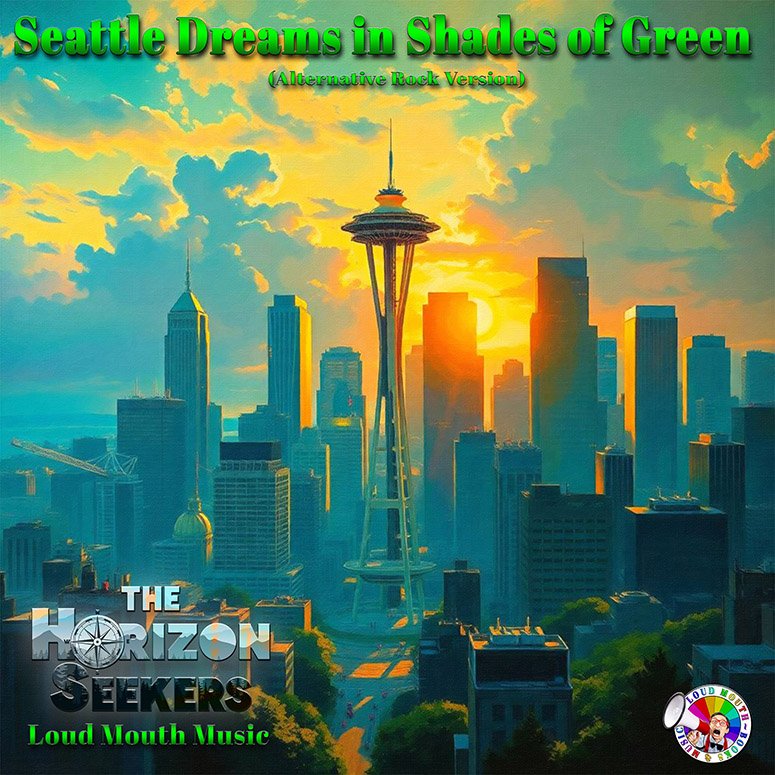
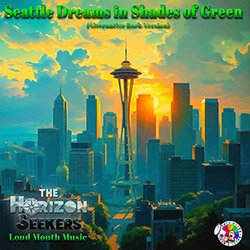
"Seattle Dreams in Shades of Green©"
Lyrics by M. S. McKenzie | Performed by American Storyteller, Protected by Copyright
~ Associated State Links ~
"Seattle Dreams in Shades of Green"
The story behind the song is Seattle seen through its shades of green. Green is the city's signature color, but I made it plural on purpose, because it's never just one green out there. It's the deep tone of the conifers, the bright leaves of spring, the gold-green of evening, the Japanese maples aflame in Washington Park, and the gardens stepping down the hills toward the water.
It moves from a twilight view off Queen Anne down through the arboretum, past the houseboats on Portage Bay, into the Chinatown-International District under its red lanterns, and out to Pike Place and the waterfront. The phrase I kept coming back to is "where cultures blend and weave." I didn't want the diversity to just coexist in the song, I wanted it to weave, the maples and cherry trees and neighborhoods and histories all crossing into one another.
That's why the ending matters to me. "In dreams we all can weave" ties the green landscape and the cultural threads together. Seattle isn't a finished thing. Each generation adds another story, another neighborhood, another shade. The song honors the famous setting, but it's really about the idea that a city's soul comes from all those lives braided together, each one adding its own green to the dream.
Uplifting adult-contemporary / melodic folk-rock city anthem.
Coexistence of nature and city, cultural diversity woven together, the many shades of green, and a city as a collective, unfinished dream.
Primary Subject:
Seattle's green landscapes and woven cultures, from Queen Anne and Washington Park to the Chinatown-International District and Pike Place.
Mood:
Warm, luminous, celebratory, and inclusive.
Seattle's beauty comes from relationships and coexistence, water and land, gardens and neighborhoods, cultures and histories woven together, with each generation adding another shade to an unfinished dream.
[Verse 1]
From Queen Anne's crown at twilight hour
The city spreads below
While Mount Rainier stands sentinel
In splendid alpine glow
The Sound wraps 'round the emerald hills
Like silver ribbons bright
As seaplanes dance with ferry boats
In fading evening light
[Chorus]
Seattle dreams in shades of green
Between waters and the sky
Where coffee flows and salt winds blow
And seagulls and eagles fly
Through urban woods and neighborhoods
Where cultures blend and weave
This city built on hills of gold
Still makes us all believe
[Verse 2]
Along the Washington Park trail
Where gardens touch the breeze
Past Japanese maples aflame
And ancient cherry trees
While houseboats bob on Portage Bay
Like memories set free
And University Bridge lifts high
To greet the sea
[Chorus]
Seattle dreams in shades of green
Between waters and the sky
Where coffee flows and salt winds blow
And seagulls and eagles fly
Through urban woods and neighborhoods
Where cultures blend and weave
This city built on hills of gold
Still makes us all believe
[Verse 3]
Through Chinatown's red lantern glow
Where history runs deep
Past bookshops old and markets bold
Where secrets keep
Down to the waterfront at dusk
Where music fills the air
While Pike Place neon’s paint the night
With colors rare
[Chorus]
Seattle dreams in shades of green
Between waters and the sky
Where coffee flows and salt winds blow
And seagulls and eagles fly
Through urban woods and neighborhoods
Where cultures blend and weave
This city built on hills of gold
Still makes us all believe
[Verse 4]
Atop Columbia Tower high
The world spreads out below
Three mountain ranges touch the clouds
In sunset's glow
Olympics, Cascades guard our home
Like giants old and wise
While urban canyons wind between
These Northwest skies
[Chorus]
Seattle dreams in shades of green
Between waters and the sky
Where coffee flows and salt winds blow
And seagulls and eagles fly
Through urban woods and neighborhoods
Where cultures blend and weave
This city built on hills of gold
Still makes us all believe
Seattle, Seattle, Seattle...
...in dreams we all can weave.
"Seattle Dreams in Shades of Green" is an expansive adult contemporary and folk-rock tribute to Seattle, portraying the city as a place suspended between saltwater, freshwater, forests, hills, mountain ranges, and changing Northwest skies. Moving from Queen Anne and Washington Park to Portage Bay, the Chinatown-International District, Pike Place Market, the waterfront, and the heights of Columbia Center, the song presents Seattle as a city whose urban identity remains inseparable from the natural world surrounding it.
The lyrics celebrate familiar landmarks, but the song is more than a geographical tour. Its deeper subject is the relationship between people and place. Seattle's gardens, houseboats, ferries, markets, bridges, neighborhood streets, cultural traditions, and towers all exist within a broader natural frame of water, trees, mountains, birds, mist, and evening light.
The title, "Seattle Dreams in Shades of Green," captures that union beautifully. Green is Seattle's defining visual color, appearing in evergreen forests, neighborhood trees, parks, gardens, hillsides, moss, and the wooded shorelines surrounding the city. Yet the plural "shades" is important. Seattle is not represented by one uniform green but by countless variations, ranging from the deep tones of conifers to the bright leaves of spring, the gold-green of evening, and the changing colors of cultivated gardens.
The word "dreams" adds an emotional dimension. The city is not merely green in appearance. It dreams through its landscape, cultural diversity, neighborhood life, artistic energy, and continual reinvention. The title suggests that Seattle itself possesses an imagination, and that everyone who lives there contributes another thread to the dream.
The song's opening verse begins from Queen Anne at twilight, providing a naturally elevated perspective over the city. Seattle's Queen Anne neighborhood contains several viewpoints from which portions of downtown, Lake Union, Puget Sound, and the surrounding mountains can be seen. The lyric therefore begins almost like a camera opening into a wide panoramic shot.
The phrase "Queen Anne's crown" gives the hill a regal personality. It is both a literal high point and a symbolic crown above the city. From that position, Seattle spreads outward below, with towers, neighborhoods, waterways, bridges, and shorelines gradually appearing as daylight fades.
Twilight is an ideal time for this scene because it allows the natural and human-made worlds to become visible at once. The mountains and water still hold the final color of the day, while windows, streetlights, ferries, and buildings begin to glow.
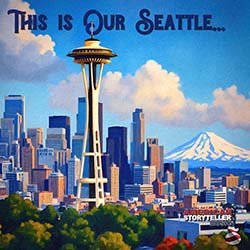
Mount Rainier stands as a sentinel beyond the city. The mountain's great scale and isolated volcanic profile give it the appearance of a distant guardian. It may disappear for days behind clouds and then suddenly dominate the horizon when the atmosphere clears.
Calling Rainier a "sentinel" gives it awareness and permanence. The city changes rapidly below, but the mountain appears to watch over generations of growth, migration, construction, and human ambition.
The phrase "splendid alpine glow" describes the warm pink, orange, or golden illumination that can touch a snow-covered summit near sunrise or sunset. Against cooler blue and gray surroundings, Rainier may seem almost internally lit.
The Sound then wraps around the emerald hills like silver ribbons. This is one of the song's strongest images because it expresses Seattle's complex relationship with water.
The city does not sit beside one simple shoreline. It is shaped by Elliott Bay, Puget Sound, Lake Washington, Lake Union, the Ship Canal, Portage Bay, and numerous smaller waterways. Water curves around hills and neighborhoods, dividing the city while also connecting it.
Describing the waterways as "silver ribbons" captures reflected twilight. Smooth surfaces catch the fading light and form bright pathways between darker landforms.
The simile also creates movement. Ribbons wind, bend, and flow, just as the waterways pass through and around Seattle's irregular geography.
The seaplanes and ferryboats introduce two characteristic forms of transportation. Seaplanes rise and descend around Lake Union, while ferries cross the marine waters beyond downtown.
The phrase "dance with ferry boats" makes their coordinated movements appear graceful. One glides across the water before lifting into the air, while the other continues steadily toward another shore.
This scene captures an essential quality of Seattle: ordinary transportation can become visually extraordinary because of its setting. A commute or routine flight occurs beneath mountains and across reflective water.
The fading evening light unifies the entire verse. Queen Anne, Rainier, the Sound, seaplanes, ferries, hills, and city towers all become part of the same changing composition.
The chorus introduces the song's central declaration: "Seattle dreams in shades of green." The line works both as description and personification.
Seattle's green character comes partly from its parks and extensive urban vegetation. The city is proud of its park system and of the beauty of its natural surroundings, while major parks preserve forests, shorelines, meadows, tidal areas, and views within the urban environment.
Yet the chorus's green is also symbolic. It represents vitality, imagination, renewal, environmental awareness, and the possibility of creating a city in which nature remains visible.
"Between waters and the sky" defines Seattle's spatial position. The city occupies a narrow, hilly landscape between large bodies of water, with mountains and sky constantly visible beyond its streets.
The lyric makes Seattle seem almost suspended between elements. Water surrounds it below, clouds and birds move above it, and buildings rise through the space between.
"Where coffee flows and salt winds blow" joins an intimate cultural detail with the city's maritime geography. Coffee represents warmth, conversation, creativity, routine, and indoor refuge. Salt wind represents the larger world of Puget Sound, shipping, islands, storms, and ocean-connected waters.
The two elements belong together. A person may sit with coffee behind a window while marine wind and rain move through the streets outside.
The seagulls and eagles represent two different aspects of Seattle's birdlife. Gulls belong to the active waterfront, docks, markets, ferries, and piers. Eagles suggest wilder shorelines, open water, height, and the continued presence of large wildlife around the metropolitan region.
The line "Through urban woods and neighborhoods" captures the city's interwoven geography. Forested parks and greenbelts often lie close to residential streets, business districts, and heavily developed areas.
Discovery Park, for example, includes forest groves, tidal beaches, meadows, dunes, cliffs, streams, and views of both the Olympic and Cascade ranges, all within the city.
The movement through woods and neighborhoods also creates a human connection. The song does not separate nature from community. Trees, houses, parks, shops, gardens, and cultural districts are all part of the same living city.
"Where cultures blend and weave" introduces Seattle's social diversity. The verb "weave" is more meaningful than simply saying that cultures coexist. Weaving suggests that traditions, communities, foods, languages, histories, and artistic influences continually cross and affect one another.
The city's Chinatown-International District developed as a cultural center shaped by Chinese, Japanese, Filipino, Vietnamese, and other Asian and Pacific Islander communities. The district includes historic Chinatown, Japantown, and Little Saigon, each contributing distinct histories to Seattle's identity.
"This city built on hills of gold" is primarily metaphorical. The hills themselves are not literally made of gold. The line suggests that Seattle's elevated neighborhoods, sunset light, opportunity, prosperity, memory, and natural beauty give the city an almost precious quality.
Gold may also refer to evening light spreading across Queen Anne, Capitol Hill, Beacon Hill, Magnolia, West Seattle, and the ridges surrounding the city.
"Still makes us all believe" gives the chorus an optimistic emotional conclusion. Seattle inspires belief in possibility: the possibility of creativity, community, reinvention, discovery, or a more harmonious relationship between urban life and nature.
The word "still" adds complexity. It implies that the city has endured hardship, change, inequality, growth pressures, and disappointment, yet retains the ability to inspire hope.
The second verse moves into Washington Park, most likely referring to the Washington Park Arboretum and its associated gardens. The Arboretum is a major urban botanical landscape, while the Seattle Japanese Garden occupies a formal garden within it.
The trail leads through a softer and more intimate world than the broad city panorama of the first verse. Instead of viewing Seattle from above, the listener now walks beneath leaves and branches.
"Where gardens touch the breeze" gives the plants a delicate form of movement. Leaves, flowers, grasses, and branches seem to meet the air and turn wind into visible motion.
The Japanese maples described as "aflame" introduce intense seasonal color. Their red and orange foliage contrasts with the song's dominant greens while remaining part of the same botanical dream.
The word "aflame" also echoes the evening glow of the first verse. Light and color repeatedly appear as forms of fire that illuminate without destroying.
The "ancient cherry trees" bring associations of spring blossoms, beauty, cultural memory, and the brevity of each season. Some Seattle parks connected to Japanese heritage contain significant cherry plantings, including the Fuji cherry trees at Kobe Terrace, which were gifts connected to Seattle's sister-city relationship with Kobe.
In the song, cherry trees carry both local and international meaning. They show how a living landscape can preserve cultural relationships and shared history.
The verse then travels to Portage Bay, where houseboats move gently on the water. Their bobbing motion gives the scene an intimate, lived-in quality.
The houseboats are compared to "memories set free." This is one of the song's most lyrical images. Memories often seem fixed within the past, but here they float, move, and respond to the current.
The line may suggest that life on the water allows people to release old burdens or rediscover earlier dreams. The houses themselves are anchored, yet they never remain completely still.
The image also expresses Seattle's balance between permanence and motion. Buildings stand on land, houseboats rise and fall on water, bridges open, ferries cross, and aircraft move between lake and sky.
The University Bridge lifting "to greet the sea" continues this theme of movement. The bridge is a bascule bridge crossing Portage Bay and the Lake Washington Ship Canal system rather than the open sea, so the word "sea" functions poetically. It represents the connected waterways leading toward Puget Sound.
The raised bridge resembles arms opening or a formal salute. A mechanical act becomes an expression of welcome.
The line also temporarily reverses the usual relationship between land and water. Roads must pause and rise so boats can pass, reminding the city that its waterways remain active corridors rather than decorative surfaces.
When the chorus returns, the reference to urban woods gains additional meaning. The listener has now walked through an actual botanical landscape and seen how cultivated gardens contribute to Seattle's green identity.
The second chorus also deepens the idea that cultures "blend and weave." Japanese maples, cherry trees, houseboats, bridges, and Northwest vegetation occupy one connected urban environment.
The third verse moves into the Chinatown-International District beneath the glow of red lanterns. The visual palette shifts dramatically from green gardens and blue water to red light, storefronts, signs, markets, and evening streets.
"Where history runs deep" recognizes that the district is not simply a picturesque destination. It is a historically significant community shaped by immigration, labor, exclusion, resilience, commerce, family life, and cultural preservation. Seattle's official historic district materials describe it as the cultural hub of the city's Asian American community and document its roots in Chinatown and Japantown.
The red lantern glow gives the verse warmth and visual identity, but the line about deep history prevents the neighborhood from being reduced to decoration.
"Past bookshops old and markets bold" celebrates the district's intellectual and commercial life. Books preserve language, memory, identity, and imagination, while markets create spaces for food, exchange, conversation, and everyday community.
The following phrase, "Where secrets keep," appears incomplete grammatically. The likely intended meaning is that the old shops and markets keep secrets or stories within them.
Possible revisions include:
"Where generations' secrets keep"
"Where hidden stories sleep"
or:
"Where old-world secrets keep."
The simplest and most lyrical alternative may be:
"Where hidden stories sleep."
The song then moves downhill toward Seattle's waterfront at dusk. This descent creates a natural transition from enclosed neighborhood streets to open water and broad sky.
Seattle's central waterfront has long been connected with maritime activity, public gathering, Pike Place Market, transportation, commerce, and cultural life. Recent waterfront development has expanded public spaces, art, recreation, and direct connections between the shoreline and Pike Place Market.
Music filling the air suggests street performers, venues, market activity, festivals, or the general mixture of voices and sound along the downtown waterfront.
The phrase is also self-referential. The city described by the song is itself producing music, and "Seattle Dreams in Shades of Green" becomes another contribution to that soundscape.
Pike Place neon then paints the night. The possessive should be written "Pike Place neon paints the night," without an apostrophe in "neon's."
Pike Place Market was established in 1907 and later preserved through citizen action as a historic district. Its continued mixture of merchants, residents, food, craft, performance, and public activity makes it an enduring symbol of Seattle.
Neon is described as paint because it spreads color across wet pavement, windows, signs, faces, and surrounding buildings. The light becomes another artistic force within the song.
The phrase "colors rare" suggests that these urban colors possess the same wonder as the gardens and sunset mountains. The song does not rank natural beauty above city beauty. It finds artistry in both.
The repeated chorus now contains a fuller definition of Seattle's dream. The city's shades of green include not only trees and gardens but living communities with deep roots and evolving identities.
The fourth verse rises to the top of Columbia Tower, more commonly called Columbia Center today. From this elevated position, Seattle and the surrounding region appear as one immense panorama.
"The world spreads out below" gives the viewpoint an almost airborne perspective. Streets become narrow channels, buildings form urban cliffs, and waterways divide the land into broad shapes.
The lyric's "three mountain ranges" is poetically understandable, although the most prominent surrounding systems are the Olympic Mountains to the west and the Cascade Range to the east, with Mount Rainier forming part of the Cascades rather than a separate range. Depending on atmospheric conditions and direction, other distant uplands may also contribute to the impression of multiple mountain walls.
A geographically precise alternative might be:
"Two mountain ranges touch the clouds"
or:
"The mountain ranges touch the clouds."
Retaining "three" can still work as a broader poetic panorama, particularly if the lyric is counting Rainier as its own dominant visual presence.
The mountains touched by sunset continue the song's repeated use of changing light. The peaks are not static shapes. Their colors respond to clouds, snow, haze, and the angle of the sun.
The Olympics and Cascades are described as guarding the city like ancient giants. This gives Seattle a feeling of enclosure and protection.
The Olympic Mountains rise beyond Puget Sound to the west, while the Cascades form the great eastern wall beyond Lake Washington and the surrounding lowlands. Seattle parks and viewpoints frequently emphasize views toward both ranges.
Calling the mountains "old and wise" suggests that they possess a perspective unavailable to the rapidly changing city. They have endured glaciation, erosion, storms, ecological succession, and human history.
The mountains guard the home not by preventing change but by placing that change within a much larger frame.
The phrase "urban canyons" describes streets running between tall downtown buildings. This is a familiar city metaphor, but it becomes especially meaningful in a song dominated by natural geography.
Seattle contains two kinds of canyons: valleys and waterways shaped by natural forces, and streets shaped by architecture. The human-made canyons echo the mountain and river landscapes beyond them.
The final phrase, "these Northwest skies," allows the city to remain open despite its towers. Buildings rise high, but the surrounding sky, clouds, mountains, and water prevent the urban environment from feeling completely enclosed.
The final chorus gathers every part of the journey. Queen Anne, Rainier, Puget Sound, Washington Park, Portage Bay, the Chinatown-International District, Pike Place Market, the waterfront, Columbia Center, the Olympics, and the Cascades become components of one city-wide dream.
The chorus's repeated contrast between coffee and salt wind is particularly effective because it brings Seattle's interior and exterior lives together. Coffee belongs to conversation, thought, and refuge. Salt wind belongs to movement, weather, and the open horizon.
The final repetition of "Seattle, Seattle, Seattle" gives the ending the quality of an affectionate invocation. The city's name becomes a melodic phrase rather than simply a location.
Each repetition could be sung with increasing harmony, as though additional voices are joining from different neighborhoods.
The concluding line, "in dreams we all can weave," brings the song's cultural and imaginative themes together. Earlier, cultures blended and wove through the city. Now the people themselves weave dreams.
Seattle is not presented as a completed work. Each generation adds new stories, music, neighborhoods, businesses, art, relationships, and ambitions.
The verb "weave" also suggests interdependence. No one person creates the city's identity. It emerges through thousands of intersecting lives.
Musically, "Seattle Dreams in Shades of Green" would work especially well as an uplifting adult contemporary, melodic folk-rock, soft-rock, or cinematic city anthem. Its arrangement should feel fluid, spacious, and sophisticated, reflecting both urban energy and Northwest atmosphere.
The opening could begin with warm electric piano, clean electric guitar, soft bass, and restrained drums. A rising string or saxophone phrase could accompany the twilight view from Queen Anne.
The first verse should gradually expand as the panorama widens. The line about Mount Rainier could receive a sustained harmonic lift, while shimmering guitar or keyboard textures reflect the silver waterways.
A brief rhythmic interplay between piano and guitar could suggest seaplanes and ferries crossing one another in the evening.
The chorus should open into fuller drums, layered backing vocals, strings, and a broad melodic line. "Seattle dreams in shades of green" is naturally suited to a memorable rising hook.
The words "between waters and the sky" could be held across longer notes, giving the singer room to express Seattle's openness and scale.
The coffee and salt-wind line might use a slightly more rhythmic vocal pattern, bringing an everyday, conversational quality into the larger anthem.
The second verse could become more delicate around Washington Park. Acoustic guitar, piano, light percussion, and violin would suit the gardens, maples, and cherry trees.
The houseboat lines might introduce a gently rocking rhythm, musically imitating movement on Portage Bay.
As the University Bridge rises, the arrangement could climb with it through strings or a melodic guitar figure.
The third verse should introduce warmer and more colorful instrumentation. Piano, hand percussion, bass, and subtle brass or woodwind accents could support the Chinatown-International District and market imagery.
The transition to the waterfront might widen the stereo field and introduce ambient guitar, strings, or distant vocal harmonies.
Pike Place neon painting the night offers an ideal point for bright keyboard tones or a brief saxophone phrase with an urban evening character.
The fourth verse should feel elevated and panoramic. Low strings could begin beneath Columbia Center, followed by a gradual orchestral expansion as the mountains and sunset appear.
The reference to the Olympics and Cascades could bring back the soaring instrumental motif associated with Rainier in the first verse, giving the song musical continuity.
The urban-canyon line might add stronger drums and electric guitar before releasing into the final chorus.
The last chorus should be the fullest section, with layered voices, strings, drums, guitar, and perhaps saxophone or violin answering the lead vocal.
"Seattle, Seattle, Seattle" could begin with the solo singer and add a new harmony on each repetition.
The final line might then soften, allowing the instruments to recede until only piano, guitar, and distant harmony remain.
An instrumental outro could return to the opening Queen Anne melody. The arrangement might fade with the suggestion of ferry horns, gentle wind, or the subtle hum of the city beneath evening skies.
At its heart, "Seattle Dreams in Shades of Green" is about coexistence. It celebrates a city where mountains remain visible beyond skyscrapers, wildlife moves above ferries, botanical gardens exist beside dense neighborhoods, and cultural history lives within modern streets.
The song does not portray Seattle as wilderness untouched by humanity. Nor does it present the city as separate from nature. Instead, it explores the complicated and often beautiful place where those worlds meet.
Its geography supports that theme. Water divides the city but also connects it. Hills complicate travel but create remarkable viewpoints. Bridges interrupt the landscape but allow communities to reach one another. Gardens bring global traditions into Northwest soil.
The cultural imagery gives the song additional depth. Seattle's dream is not created only by scenery. It is shaped by the people who built communities, preserved markets, established gardens, opened bookshops, shared food, made music, and carried traditions across generations.
The lyric also captures the dual nature of Seattle's identity. It is introspective and outward-looking, urban and wooded, technologically modern and deeply conscious of history, frequently clouded yet filled with color.
"Seattle Dreams in Shades of Green" is therefore both a panoramic city anthem and a celebration of collective imagination. It honors Seattle's famous setting while recognizing that scenery alone does not create a city's soul.
Its deepest message is that Seattle's beauty comes from relationships: between water and land, towers and mountains, gardens and neighborhoods, history and change, individual memory and shared culture.
The city continues to dream because its people continue to weave. Beneath Rainier, between the Olympics and Cascades, and among waterways reflecting the evening light, each life adds another shade of green.

















.jpg)