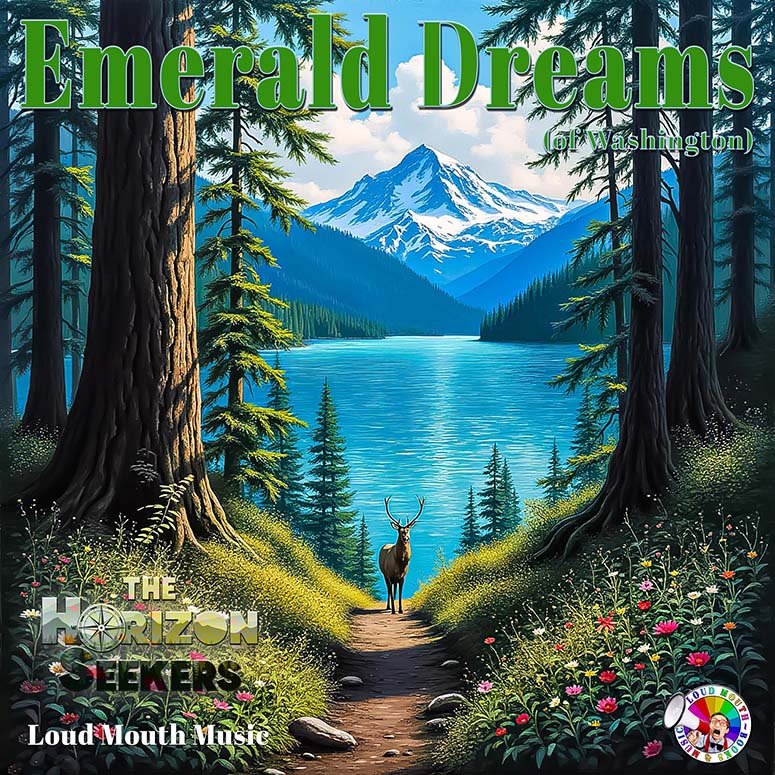
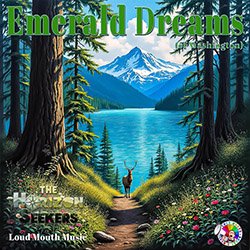
"Emerald Dreams©"
Lyrics by M. S. McKenzie (Unless Otherwise Noted) | Music Performed by Songs Across America or American Storyteller Music, All Songs Are Protected by Copyright
~ Associated State Links ~
"Emerald Dreams (in Washington)"
The story behind the song is my attempt to fit all of Washington into one journey. People picture the state as nothing but rain and evergreens, and I love that side of it, the Hoh rainforest, the Roosevelt elk, Ruby Beach. But I wanted the song to keep traveling, across Puget Sound with the orcas and ferries, up the Cascade volcanoes, through the Columbia Gorge, and out onto the golden Palouse and the dry sage country in the east.
The chorus is where the whole thing comes together for me. "From desert sage to glacial peaks" is really the argument of the song, that Washington is not one landscape but many connected worlds, tied together by water. Mountain snow feeds the rivers, the rivers cross the range, salmon come back from the sea, and irrigation turns the dry valleys into orchards. When I say the state makes me whole, I mean the variety itself is the thing I love.
Underneath the travelogue there's a quiet promise. Calling these lands sacred and saying we have got to keep them is the conservation heart of the song, and it comes out of gratitude more than warning. I wanted it to celebrate the beauty first and let the responsibility follow naturally from loving the place.
Expansive folk-rock / cinematic Americana statewide anthem.
Geographic diversity and unity, water as the connecting force, home and belonging, and conservation born of gratitude.
Primary Subject:
The full geographic range of Washington State, from the Olympic rainforest to the eastern Palouse and scablands.
Mood:
Uplifting, expansive, grateful, and reverent.
Washington's identity comes from unity through contrast, rainforest to sage, ocean to orchard, all connected by water, and loving that variety means committing to protect it.
[Verse 1]
Through the Hoh's emerald halls
Where Roosevelt elk softly call
Olympic peaks touch misty skies
While Ruby Beach waves arise
Ancient trees stand guard so strong
Where moss and fern sing nature's song
In this rainforest paradise
Where time stands still in forest light
[Chorus]
Washington, you're in my soul
From mountain peaks to tidepool shores
Your waters wild, your forests deep
These sacred lands we've got to keep
From desert sage to glacial peaks
Washington, you make me whole
[Verse 2]
Orcas dance in Puget Sound
Where ferries glide their daily rounds
San Juan Islands jewels of green
Where eagles soar so wild and free
Seattle's towers touch the clouds
While Mount Rainier stands proud and crowned
These waters hold so many tales
Of salmon runs and migrant whales
[Verse 3]
Baker wears its glacial crown
While Adams watches southward down
Rainier rises grand and high
Ancient guardian in the sky
Through meadows filled with wildflower dreams
Past alpine lakes and mountain streams
These sentinel peaks stand watch and ward
Over this land we can't ignore
[Verse 4]
The Columbia cuts its ancient way
Through towering cliffs of yesterday
Multnomah Falls its silver veil
While wind surfers catch the gale
The River Wild still flows on through
Past ancient walls of every hue
These waters carved by nature's hand
This gorge so mighty, wild and grand
[Verse 5]
The Palouse rolls in waves of gold
Where wheat fields tell the stories old
Through channeled scablands carved by time
Where meadowlarks sing songs sublime
Past Dry Falls' ancient thunder sound
Through apple orchards valley crowned
This eastern land of sun and sage
Still writes its story page by page
[Chorus]
Washington, you're in my soul
From mountain peaks to tidepool shores
Your waters wild, your forests deep
These sacred lands we've got to keep
From desert sage to glacial peaks
Washington, you make me whole
"Emerald Dreams (in Washington)" is a broad, uplifting tribute to the extraordinary geographic diversity of Washington State. Traveling from the rain-soaked forests and rugged beaches of the Olympic Peninsula to Puget Sound, the Cascade volcanoes, the Columbia River Gorge, the Palouse, and the dry landscapes of eastern Washington, the song presents the state as a meeting place of water, wilderness, wildlife, agriculture, and dramatic geological history.
The song's title captures both Washington's celebrated greenery and the dreamlike atmosphere created by its forests, islands, mountains, and mist. "Emerald" refers most directly to the deep greens of moss, fern, cedar, spruce, and fir, but it can also describe the islands of Puget Sound, alpine meadows, river valleys, and cultivated fields that brighten the landscape between mountains and water.
The word "dreams" gives the song an emotional and imaginative dimension. Washington is not presented merely as a collection of destinations. Its landscapes seem to enter the narrator's inner life, becoming places of memory, belonging, wonder, and renewal. The parenthetical phrase "in Washington" grounds those dreams within a specific state while preserving the title's lyrical quality.
The song is structured as a statewide journey. Each verse explores a different region, ecosystem, or visual identity, while the chorus gathers them into a single declaration of love and responsibility. Rainforest and desert, city and wilderness, ocean and wheat field all belong to the same Washington story.
The first verse begins in the Hoh Rain Forest, one of the song's most richly atmospheric settings. The phrase "emerald halls" transforms the forest into an immense natural cathedral. Moss-draped trees rise like columns, interlocking branches create a vaulted canopy, and filtered green light gives the interior an almost sacred appearance.
The Hoh is not described simply as dense vegetation. It feels architectural, ancient, and protective. Entering it resembles stepping into a different world where human schedules and city noise lose their importance.
Roosevelt elk calling softly through the forest bring both sound and wildlife into the opening scene. Their presence reinforces the scale and wildness of the Olympic Peninsula. These large animals can move quietly through the undergrowth, appearing and disappearing among ferns, tree trunks, and mist.
The Olympic Mountains then rise above the forest into cloud and fog. Their peaks connect the lowland rainforest with the alpine world, reminding the listener that Olympic National Park contains multiple ecosystems within a relatively compact region.
Ruby Beach brings the verse from forest to ocean. Waves rise beyond driftwood, dark sand, and offshore sea stacks, creating one of Washington's most dramatic meetings between land and water.
The transition from the Hoh to Ruby Beach reflects one of the Olympic Peninsula's defining qualities. Ancient rainforest, wild rivers, mountains, and Pacific coastline exist close together, allowing the traveler to move between radically different environments within a single journey.
The ancient trees standing guard give the forest a protective personality. They seem to watch over the elk, ferns, rivers, and younger vegetation beneath them.
The phrase "moss and fern sing nature's song" turns the forest into a living musical composition. Leaves move, water drips, birds call, branches creak, and wind passes through the canopy. Even plants without literal voices seem to participate in the sound of the landscape.
Calling the Hoh a "rainforest paradise" expresses wonder while acknowledging the moisture that sustains its extraordinary growth. Rain is not an inconvenience here. It is the creative force that supports the forest's abundance.
The final line, "Where time stands still in forest light," captures the psychological effect of the setting. The forest does not literally stop time, but its age, silence, and filtered light make the modern world feel distant.
The chorus expands from Olympic National Park to the entire state. "Washington, you're in my soul" establishes that the narrator's relationship with the land is personal rather than merely observational.
The state has become part of his emotional identity. Mountains, rivers, forests, and shorelines are not simply places he has visited. They have shaped how he understands beauty, freedom, home, and responsibility.
"From mountain peaks to tidepool shores" summarizes Washington's vertical and ecological range. Snow and ice dominate the high elevations, while tidepools along the Pacific coast support sea stars, anemones, mussels, crabs, and other marine life.
The phrase connects two environments that appear entirely different but are linked by water. Mountain snow feeds rivers, rivers reach estuaries, and those waters eventually join the Pacific.
"Your waters wild, your forests deep" identifies the two dominant elements running through much of the song. Washington is shaped by rainfall, rivers, lakes, glaciers, bays, straits, and ocean currents, as well as by evergreen and temperate forests.
The declaration that these lands are sacred and must be kept introduces the song's conservation message. Sacredness here can be understood ecologically, culturally, spiritually, or emotionally. The landscapes deserve protection because they sustain life, preserve history, and offer experiences that cannot be recreated once lost.
"From desert sage to glacial peaks" expands the popular image of Washington. The state is often associated almost exclusively with rain and evergreen forest, yet the Cascade Range creates a major climatic divide. Eastern Washington contains dry plateaus, sagebrush country, agricultural lands, and open skies.
The final line, "Washington, you make me whole," presents the landscape as restorative. The narrator feels more complete when surrounded by the state's natural variety. Its environments provide both excitement and peace, scale and intimacy, solitude and connection.
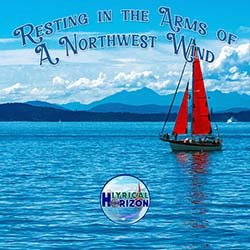
The second verse enters Puget Sound, where orcas become the central image. Their movement through the water introduces grace, intelligence, family bonds, and the wild marine life existing beside major population centers.
The phrase "Orcas dance in Puget Sound" gives their movement a joyful and almost choreographed quality. Their surfacing, diving, and travel through island channels can appear rhythmic, especially when several animals move together.
The ferries provide a distinctly Washington image. They cross the Sound as part of daily life, carrying workers, residents, students, vehicles, and travelers between islands, peninsulas, and cities.
"Where ferries glide their daily rounds" emphasizes routine rather than spectacle. For some people, the water crossing is not an occasional attraction but a normal part of transportation and regional identity.
The ferries also serve as moving viewpoints. Passengers may see mountains, islands, city skylines, seabirds, seals, and occasionally whales while traveling through an ordinary day.
The San Juan Islands appear as "jewels of green," scattered across blue water. The comparison captures both their beauty and their individual shapes, as though each island were a separate gem within the marine landscape.
Eagles soaring above the islands reinforce the themes of freedom and wilderness. Their flight connects sea, forest, shoreline, and sky.
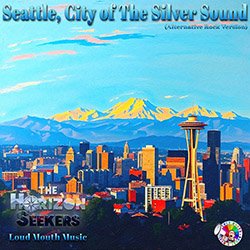
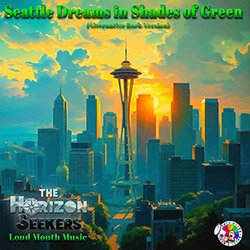
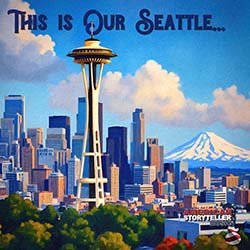
The verse then brings Seattle into view. Its towers rise into cloud and mist, placing a modern city within the same landscape as orcas, islands, ferries, and eagles.
Seattle is not presented as an interruption of nature but as another layer within the region. Urban architecture stands between Puget Sound and the Cascade Mountains, shaped visually and economically by the surrounding waters.
Mount Rainier provides the dominant natural presence above the city. Describing it as "proud and crowned" refers to its glacial summit and commanding elevation.
The mountain appears almost regal, standing above the metropolitan region like a distant monarch or guardian. Its visibility changes with weather, making each clear appearance feel dramatic.
"These waters hold so many tales" introduces the historical and ecological depth of Puget Sound. The waterways carry stories of Indigenous nations, fishing communities, maritime trade, shipbuilding, settlement, migration, industry, and environmental change.
Salmon runs represent one of the region's most important natural cycles. Salmon connect ocean, river, forest, wildlife, and human culture. Their return inland carries marine nutrients into watersheds and supports species from orcas to eagles.
Migrating whales expand the verse beyond resident marine life. Their journeys connect Washington's waters with much larger ocean systems, reinforcing the idea that the state's ecology does not end at its political boundaries.
The third verse rises into the Cascade volcanoes. Mount Baker, Mount Adams, and Mount Rainier become a line of snow-covered sentinels watching over western and central Washington.
Mount Baker "wears its glacial crown," again using the language of royalty to describe ice and snow around a volcanic summit.
The glacier imagery conveys both majesty and vulnerability. These ice fields help shape rivers and ecosystems, but they are also sensitive to long-term climatic change.
Mount Adams is described as watching southward, giving the peaks individual personalities and positions within the range. The volcanoes appear to observe one another across distance.
Rainier rises "grand and high" as an ancient guardian. Although the mountain is geologically active rather than ancient in the deepest planetary sense, it feels timeless within human experience.
Calling it a guardian reflects the way it dominates regional identity. It appears on signs, art, photographs, names, and memories, acting as a visual anchor for much of western Washington.
The meadows filled with wildflower dreams bring color and delicacy beneath the massive peaks. During the short alpine summer, flowers bloom intensely across slopes that may remain snow-covered for much of the year.
These flowers represent both abundance and impermanence. Their season is brief, making their beauty feel especially precious.
Alpine lakes and mountain streams carry snowmelt downhill, connecting the volcanoes to forests, farms, cities, and coastal waters. The mountains do not stand apart from the rest of the state. Their water influences life far below.
The peaks are called sentinels that "stand watch and ward." This older phrasing gives them a ceremonial and protective role.
They guard not through deliberate action but through presence. Their scale reminds people that the landscape existed before modern settlement and will continue changing long after present generations.
The final line, "Over this land we can't ignore," turns admiration into obligation. These mountains demand attention because of their beauty, ecological importance, cultural meaning, and potential power.
The fourth verse reaches the Columbia River Gorge. The Columbia cuts through towering cliffs, carrying water across the Cascade barrier and creating one of the Northwest's most dramatic river corridors.
The river's "ancient way" refers to its long geological history and persistent movement through a landscape affected by uplift, volcanic activity, floods, and erosion.
The towering cliffs are described as belonging to "yesterday," suggesting that they preserve the visible past. Layered basalt and weathered walls reveal repeated chapters of the region's geological development.
Multnomah Falls appears as a silver veil descending beside the gorge. The image is graceful and visually effective, although Multnomah Falls is located on the Oregon side of the Columbia River Gorge. Its inclusion still fits a broader song about Washington because the Gorge is a shared interstate landscape, visible and experienced as one connected region from both sides of the river.
The falling water resembles silver because of reflected light, white spray, and the contrast with dark rock and green forest.
Wind surfers catching the gale introduce speed, color, and recreation. Strong winds moving through the Gorge make it an internationally recognized setting for wind-driven sports.
Their movement across the water contrasts with the deep geological timescale of the cliffs. Human figures pass quickly across a landscape shaped through millions of years.
The phrase "The River Wild still flows on through" presents the Columbia as enduring and untamed, though much of the river system has been extensively altered by dams, navigation, development, and industry.
Within the song, "wild" refers to the river's scale, current, weather, history, and inability to be reduced entirely to human control.
The cliffs of many hues add color beyond the familiar evergreen landscape. Gray, brown, black, gold, green, and reddish tones appear across exposed rock, forests, seasonal vegetation, and changing light.
The river is credited with carving the gorge through nature's hand. This personification joins the Columbia with the other creative waters in the song.
The final line, "This gorge so mighty, wild and grand," gives the verse an anthem-like conclusion. The Gorge is both corridor and monument, connecting the dry interior with the wetter western region.
The fifth verse crosses the Cascades into eastern Washington and reveals another side of the state. The Palouse rolls in waves of gold, transforming agricultural hills into an inland sea.
The wave comparison is especially effective because the Palouse's rounded hills create a flowing visual rhythm. Wheat fields follow their contours, changing color with the seasons.
The golden fields tell "stories old," referring to generations of farming, regional communities, changing agricultural practices, and the deeper natural history beneath the cultivated surface.
The song then enters the Channeled Scablands, a landscape dramatically shaped by enormous Ice Age floods. The word "carved" connects these flood channels to the river and canyon imagery used throughout the song, though the scale and speed of the shaping events were radically different.
The scablands contain coulees, dry channels, exposed basalt, potholes, and other features that reveal the force of catastrophic water.
Meadowlarks singing across this open country provide a bright and familiar sound. Their songs differ from the enclosed acoustics of the rainforest or canyon, carrying across broad grassland and farmland.
The phrase "songs sublime" gives the modest bird call emotional importance. Beauty in eastern Washington is not limited to dramatic geological formations. It can be found in open air, grass, and a single voice crossing the fields.
Dry Falls introduces the ghost of an ancient waterfall far larger than the active falls seen elsewhere in the song. Its "thunder sound" no longer exists, but the landscape invites the listener to imagine the immense floods that once moved through it.
The contrast between present silence and imagined ancient thunder gives the location a haunting power. It is evidence of water that has vanished while leaving the shape of its force behind.
Apple orchards bring cultivation, color, fragrance, and harvest into the eastern landscape. Irrigated valleys support one of Washington's best-known agricultural products, creating green corridors within drier country.
The phrase "valley crowned" suggests orchards spreading across slopes and river basins like living decoration.
The final couplet identifies eastern Washington as a land of sun and sage. This directly counters the assumption that the entire state is wet and heavily forested.
"Still writes its story page by page" returns to the song's central idea that landscapes remain unfinished. Agriculture changes, rivers continue moving, erosion reshapes land, and communities add new layers of history.
The final chorus gathers the state's full range into one declaration. The listener has traveled through rainforests, beaches, marine waters, islands, cities, volcanoes, river gorges, wheat fields, scablands, orchards, and sage country.
The phrase "Washington, you're in my soul" now feels fully supported by that journey. The narrator's bond belongs not to one region but to the state's remarkable contrasts.
Musically, "Emerald Dreams (in Washington)" would work especially well as an expansive folk-rock, adult contemporary, country-rock, or cinematic Americana anthem. The arrangement should be melodic, uplifting, and spacious enough to accommodate the song's changing regional character.
The first verse could begin with fingerpicked acoustic guitar, soft piano, and atmospheric strings. Gentle percussion and water-like instrumental textures could evoke the Hoh's rain and filtered forest light.
The chorus should broaden with stronger drums, bass, layered harmonies, and a soaring electric-guitar or violin line. The title declaration to Washington has the potential to become a strong, communal hook.
The second verse might add rhythmic movement to reflect ferries and marine travel. Clean guitar, piano, or a light saxophone phrase could capture the Puget Sound atmosphere.
The line about orcas could be supported by a flowing bass figure, while the Seattle and Rainier imagery might bring a gradual orchestral rise.
The Cascade verse should sound elevated and majestic. Strings, tom drums, and sustained guitar could expand beneath the volcanoes and alpine meadows.
The Columbia Gorge verse could introduce stronger rhythmic energy, reflecting river current and wind. Drums and guitar might become more propulsive around the wind-surfing imagery.
The Palouse verse should shift into a warmer, more open sound. Acoustic guitar, fiddle, mandolin, or harmonica could suggest wheat fields, rural roads, and broad eastern skies without becoming heavily traditional.
The Dry Falls lines could briefly darken or widen musically to convey the imagined force of the ancient floods.
The final chorus should be the fullest section, combining the atmospheric qualities of the western verses with the open-country sound of the east. Layered voices could emphasize "from desert sage to glacial peaks," musically joining both sides of the state.
An instrumental outro could restate the chorus melody while gradually returning to the softer forest atmosphere of the beginning. The song might fade with acoustic guitar, strings, or a distant eagle-like guitar phrase, suggesting that the journey continues beyond the final lyric.
At its heart, "Emerald Dreams (in Washington)" is a song about unity through contrast. Washington is not one landscape but many connected worlds.
Rain falls upon the Olympic forests, glaciers feed mountain streams, rivers cross the Cascades, salmon return from the sea, and irrigation brings water into orchards and fields. The state's different regions are linked through natural systems even when they look completely unlike one another.
The song also recognizes that Washington's identity comes from both wild and human-shaped environments. Rainforests, islands, volcanoes, farms, cities, ferries, orchards, and wheat fields all contribute to its character.
Its conservation message emerges naturally from the narrator's love. To say the state makes him whole is also to acknowledge that its waters, forests, wildlife, and open spaces must not be taken for granted.
"Emerald Dreams (in Washington)" is therefore both a statewide travel anthem and a pledge of stewardship. It celebrates Washington's beauty while asking listeners to protect the landscapes that make such wonder possible.
Its deepest message is that home can be composed of many different environments. The narrator finds belonging in green rainforest light, saltwater channels, snowy volcanoes, wind-carved gorges, golden farmland, and sagebrush plains. Together, these places form one enduring dream, written across Washington from tidepool shore to glacial peak.








.jpg)