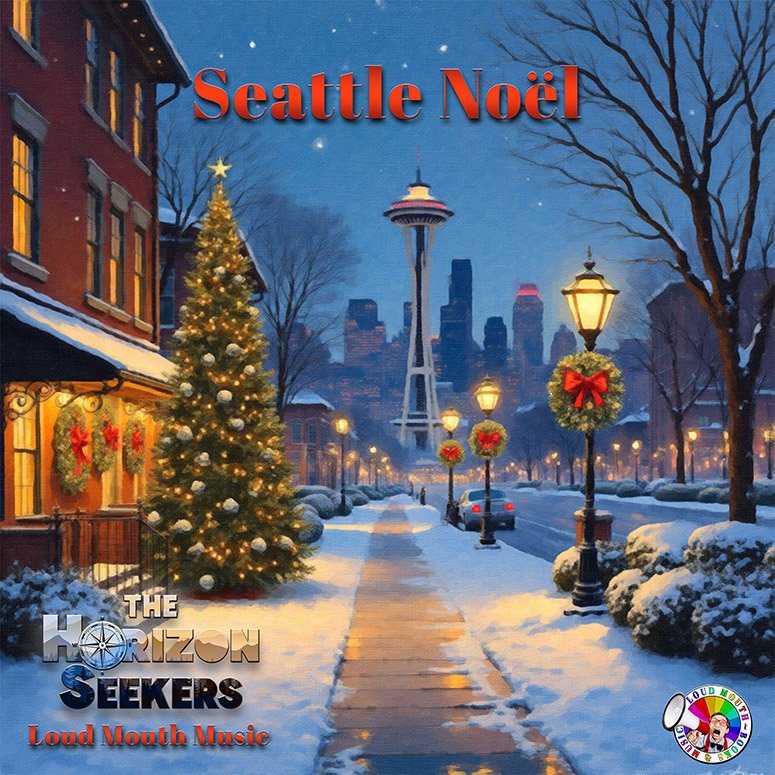
"Seattle Noel©"
Lyrics by M. S. McKenzie | Performed by The Horizon Seekers, Protected by Copyright
~ Associated State Links ~
"Seattle Noel"
The story behind the song is a Christmas carol that could only belong to Seattle. Most holiday songs lean on deep snow and sleigh bells, but that isn't our December. Ours is soft rain on the windowsill, silvery clouds, coffee steam, ferry lights crossing the dark water, and maybe a few snowflakes that dissolve into the rain. I wanted to build the whole season out of those real local details instead of borrowing someone else's winter.
What matters most to me in it is that the joy rises out of the weather rather than waiting for it to change. "Our spirits rise under the cloudy, silvery skies" is the heart of the song. Christmas doesn't need perfect snow. It needs people, gathered at Pike Place, at the hot cocoa stands, in old church halls lit by candles, in a rain-soaked timber town that still glows from the inside.
The bridge, where snowflakes mix with the city rain and memories mingle like sweet champagne, is where it turns from scenery to feeling. Every corner holds someone's story, young and old, of Decembers past. By the last chorus I wanted it to belong to the whole city, so that even under those silver clouds, Christmas love really is all around.
Gentle adult-contemporary Christmas song / soft-rock holiday ballad.
Christmas and community, finding light in the darkest season, local identity and memory, and warmth against the cold.
Primary Subject:
A Seattle Christmas built from rain, coffee, ferry lights, Pike Place, and gathered community.
Mood:
Warm, intimate, nostalgic, and gently joyful.
Holiday warmth doesn't depend on perfect snow or clear skies. It is created wherever people gather, remember, and offer warmth to one another, even in a rain-soaked city.
[Instrumental Intro]
[Verse 1]
Rain taps softly on windowsills
Emerald lights in the silent hills
Coffee steam and mistletoe
Christmas in the city
With hearts aglow
[Chorus]
Oh
Seattle Noël
Our spirits rise
Under the cloudy
Silvery skies
In this rain-soaked
Timber town
Christmas love
...is all around
[Verse 2]
Pike Place Market
Bustling cheer
Fishermen's cries in the frosty air
Hot cocoa stands and laughter shared
Winter's breath, we're all prepared
[Chorus]
Oh
Seattle Noël
Our spirits rise
Under the cloudy
Silvery skies
In this rain-soaked
Timber town
Christmas love
...is all around
[Verse 3]
Gas Works Park
Where frosty pipes gleam
Twinkling ferryboats
A yuletide dream
Candles flicker in the old church halls
Whispers of history in the snowfall
[Bridge]
Snowflakes mix with the city rain
Memories mingle like sweet champagne
In every corner
Stories told
Of Decembers past
Of young and old
[Chorus]
Oh
Seattle Noël
Our spirits rise
Under the cloudy
Silvery skies
In this rain-soaked
Timber town
Christmas love
...is all around
[Chorus]
Oh
Seattle Noël
Our spirits rise
Under the cloudy
Silvery skies
In this rain-soaked
Timber town
Christmas love
...is all around
[Instrumental outro]
"Seattle Noël" is a gentle adult contemporary Christmas song that captures the holiday season through the unmistakable atmosphere of Seattle. Rather than relying upon the deep snow, sleigh bells, and frozen countryside found in many traditional Christmas songs, it builds its seasonal world from soft rain, silvery clouds, steaming coffee, ferry lights, Pike Place Market, historic churches, mistletoe, and the occasional snowfall mingling with the city's familiar winter weather.
The song's greatest strength is its sense of place. Christmas could be celebrated almost anywhere, but "Seattle Noël" belongs specifically to the Pacific Northwest. The city's rain, evergreen hills, waterfront activity, industrial landmarks, coffee culture, and maritime character are not merely background details. They shape the mood and personality of the celebration.
The title combines the city's name with the French word "Noël," traditionally associated with Christmas and Christmas music. The accented spelling gives the title a slightly elegant, timeless quality, suggesting a modern city carol rather than a novelty holiday song. It also separates the song from more familiar Christmas titles and gives it a memorable regional identity.
Although the lyrics include recognizable locations, the song is not structured as a sightseeing tour. It is primarily about emotional atmosphere. Seattle becomes a place where people find warmth beneath overcast skies, where holiday brightness is created not by perfect weather but by community, memory, and affection.
The instrumental introduction could immediately establish that mood through warm electric piano, soft acoustic guitar, brushed drums, and gentle sleigh bells. A clean electric-guitar melody with light reverb could evoke rain reflecting downtown lights, while subtle strings might introduce the emotional warmth that grows throughout the song.
The arrangement should avoid sounding excessively grand at the beginning. The opening scene is intimate: rain touching a windowsill, coffee rising in steam, and homes or businesses glowing softly within a dark winter city.
The first verse begins with rain tapping gently against the windows. The word "softly" is important because the weather is not portrayed as harsh or dreary. It creates rhythm and shelter.
The listener can imagine being indoors while rain falls outside, perhaps in a coffee shop, apartment, hotel, or family home. The window becomes a boundary between the cold city and the warmth within.
Rain replaces the conventional snowfall of a Christmas song, giving the lyric an authentically Seattle character. It also provides natural percussion, almost as though the city itself is joining the instrumental introduction.
"Emerald lights in the silent hills" connects Seattle's greenery with holiday illumination. The phrase may suggest evergreen trees, decorated neighborhoods, distant homes, or light reflected across wet hillsides.
The word "emerald" is especially appropriate for a city and region strongly associated with green landscapes. During winter, evergreen trees preserve color when many other plants have gone dormant.
The hills are described as silent, creating a peaceful nighttime setting. Seattle's neighborhoods rise and fall across uneven terrain, and lights viewed across those slopes can appear like scattered ornaments.
The image also balances urban life with surrounding nature. Even within the city, trees, hills, water, weather, and distant mountains remain part of the visual experience.
"Coffee steam and mistletoe" brings together two different kinds of warmth. Coffee represents physical comfort, conversation, and Seattle's well-known café culture. Mistletoe represents affection, tradition, and romantic possibility.
The rising steam mirrors the mist outside, connecting the interior and exterior worlds. One is warm and fragrant, while the other is cold and atmospheric.
The short concluding lines, "Christmas in the city / With hearts aglow," summarize the verse's emotional movement. The city may be dark, rainy, and cloud-covered, but the people within it provide light.
"Hearts aglow" transforms holiday illumination into an emotional condition. Storefronts, trees, candles, and streetlights may shine visibly, but kindness, anticipation, and togetherness create the more important radiance.
The chorus introduces the song's central declaration: "Oh, Seattle Noël." The opening "Oh" gives it the quality of a carol or affectionate address, as though the singer is speaking directly to the city.
The phrase is simple enough to become a memorable holiday hook. Its spaced presentation in the lyric suggests that each word may receive its own melodic emphasis.
"Our spirits rise" expresses uplift despite the season's heavy skies. The song does not deny Seattle's winter weather. It finds hope within it.
This is one of the lyric's defining ideas. Joy does not require clear skies. People can celebrate beneath clouds, rain, and early darkness because the source of their happiness is communal and internal.
The "cloudy, silvery skies" are described beautifully rather than negatively. Silver suggests reflected light, elegance, calm, and the muted brightness of winter.
Cloud cover can soften the entire landscape, reducing sharp contrasts and allowing lights to glow against a pale gray background. The song turns that familiar weather into part of the seasonal decoration.
Calling Seattle a "rain-soaked timber town" connects the modern city with its historical and regional relationship to timber, forests, trade, and the natural resources of the Pacific Northwest.
The phrase has a rustic, almost frontier quality, even though present-day Seattle is a large, technologically advanced metropolitan city. That contrast gives the chorus character.
"Timber town" also fits the Christmas imagery because evergreen trees, wooden buildings, wreaths, firesides, and forest scents are closely associated with the season.
The final declaration, "Christmas love is all around," provides the chorus with its emotional resolution. The staggered line break before "is all around" allows the phrase to bloom musically.
Love is not confined to one couple or family. It appears across markets, churches, ferries, coffee stands, streets, and neighborhoods.
The phrase could support layered backing vocals, with the main singer delivering "Christmas love" and harmonies answering or sustaining "all around."
The second verse moves into Pike Place Market, one of Seattle's most recognizable public spaces. During the holiday season, the market becomes a natural gathering place filled with shoppers, vendors, food, decorations, music, and conversation.
The phrase "bustling cheer" creates immediate movement after the quiet first verse. The song shifts from private indoor warmth to public celebration.
Fishermen's cries in the frosty air evoke the market's energetic traditions and maritime identity. The calls of vendors contribute a distinctly local sound to the Christmas scene.
The word "frosty" should not necessarily be taken to mean severe cold. It suggests a crisp winter atmosphere, visible breath, chilled waterfront air, and the need for warm drinks and coats.
Hot cocoa stands add sweetness and comfort. The drink becomes a small communal ritual, shared by children, families, couples, shoppers, and visitors moving through the market.
The laughter around those stands reinforces the song's emphasis on ordinary human connection. Its Christmas spirit is found in small public moments rather than elaborate spectacle.
"Winter's breath, we're all prepared" suggests coats, scarves, umbrellas, warm cups, and the regional habit of continuing daily life despite damp weather.
The line also carries a wider emotional meaning. People are prepared not only for winter temperatures but for the rituals, memories, and gatherings of the holiday season.
When the chorus returns, the contrast between Pike Place's activity and the cloudy skies becomes more pronounced. The city's joy rises directly out of its weather rather than waiting for it to change.
The third verse moves to Gas Works Park, one of the song's most distinctive choices. The park's preserved industrial structures create an unconventional Christmas scene.
"Frosty pipes gleam" transforms former industrial machinery into seasonal sculpture. Metal surfaces catch pale daylight, city glow, or reflected waterfront light.
The word "frosty" softens the machinery and temporarily changes its appearance. Pipes and towers that might ordinarily seem dark or utilitarian become bright and almost decorative.
This is a particularly effective Seattle image because it finds beauty in the coexistence of industry, history, recreation, and landscape.
The twinkling ferryboats introduce movement across the water. Their lights appear small against the dark Sound, resembling floating Christmas decorations.
Ferries are part of everyday regional transportation, yet at night they can look dreamlike as they cross between illuminated shores.
Calling them a "yuletide dream" turns an ordinary commute into holiday imagery. The song repeatedly discovers seasonal beauty within familiar Seattle routines.
The verse then moves into old church halls, where candles flicker. This scene introduces a more traditional and reverent side of Christmas.
The warm, unstable light of candles contrasts with the metallic gleam of Gas Works Park and the electric lights of the ferries. Seattle's Christmas is shown through several eras and forms of illumination.
"Whispers of history in the snowfall" suggests that the churches, buildings, streets, and waterfront all carry memories of earlier Decembers.
The snowfall may be literal, even if snow is less constant than rain in the city, but it also creates a momentary transformation. Familiar architecture becomes quieter and softer beneath falling flakes.
The line joins history and weather. Snow settles temporarily upon old structures, while memory settles across generations.
The bridge deepens the song's nostalgic quality. Snowflakes mix with city rain, creating a weather pattern that perfectly symbolizes Seattle's version of Christmas.
Rain and snow represent two forms of the same water. One belongs to the city's familiar winter reality, while the other carries the traditional imagery of Christmas.
Their mixture suggests that Seattle does not need to imitate another region's holiday atmosphere. Its Christmas identity comes from the meeting of the expected and the local.
"Memories mingle like sweet champagne" introduces a celebratory comparison. Individual memories blend together, becoming something sparkling, bittersweet, and shared.
Champagne also suggests gatherings, toasts, reunions, and the passage from one year into another. The line extends the song beyond Christmas Day toward the broader holiday season.
The comparison works because memory, like champagne, can rise unexpectedly. A scent, song, building, snowfall, or familiar street may release moments thought long forgotten.
"In every corner / Stories told" presents the city as an archive of personal experience. Every neighborhood, café, market stall, church, park, and ferry route may carry someone's holiday story.
The stories belong to both young and old, emphasizing continuity across generations. Children experience the season as something new, while older people recognize traditions and remember those who celebrated before them.
"Decembers past" acknowledges that Christmas is rarely experienced only in the present. Each new holiday is compared consciously or unconsciously with earlier ones.
That memory may be joyful, wistful, or painful. The song keeps the emotional tone warm, but the phrase allows room for the complexity of the season.
The final repeated choruses transform the song from a series of local scenes into a communal anthem. Repetition makes the central message feel inclusive and reassuring.
The first final chorus could retain the established arrangement, while the second might grow through fuller drums, strings, bells, and layered harmonies.
A choir-like backing vocal could enter on "Our spirits rise," suggesting voices from across the city joining together.
The phrase "Christmas love is all around" could be extended during the final repetition, allowing harmonies to overlap and echo before the instrumental outro begins.
The outro should preserve the warmth of the song rather than end abruptly. Electric piano or acoustic guitar could restate the chorus melody while strings and sleigh bells gradually recede.
A saxophone would also fit the adult contemporary style, particularly if played softly and melodically rather than as a large solo. Its warm tone could resemble light drifting through rain.
Subtle waterfront ambience, distant ferry horns, or gentle rainfall could appear near the end. These sounds should remain understated, allowing the music to carry the emotional conclusion.
The final note might be sustained over the sound of rain, returning the listener to the windowsill of the opening verse. This would give the song a circular structure.
Musically, "Seattle Noël" would be especially effective as a late-1970s or early-1980s adult contemporary Christmas recording, a soft-rock holiday ballad, or a sophisticated seasonal pop song.
A moderate tempo would suit the lyrics better than either a slow hymn or a fast novelty arrangement. The song should feel like walking through the city at night, warm enough to be comforting but rhythmic enough to suggest activity.
Electric piano could provide the primary harmonic foundation. Acoustic guitar would add warmth, while clean electric guitar could supply shimmering rain-like accents.
Brushed drums or a soft snare pattern would preserve the intimate tone. Sleigh bells could appear selectively in the chorus rather than continue throughout the entire song.
Strings would work well beneath the silvery skies, ferries, candles, and memory imagery. A restrained brass or woodwind arrangement might add sophistication during the later choruses.
The lead vocal should sound affectionate and sincere rather than overly theatrical. The singer is not announcing a grand holiday spectacle. He is observing the small details that make the season meaningful.
The verses could be delivered conversationally, while the chorus should open into longer notes and richer harmony.
The lyric's short line structure gives it natural room for pauses. Those spaces can allow instrumental responses, echoes, and atmospheric textures to enter between phrases.
At its heart, "Seattle Noël" is about creating warmth within a cool and rain-darkened environment. Its holiday spirit emerges through contrast.
Rain falls, but coffee steams. Clouds cover the sky, but spirits rise. Industrial pipes turn silver with frost. Ferryboats become floating lights. Old churches hold candles and memories.
The song also demonstrates that local identity can strengthen familiar holiday traditions. Christmas does not need to look the same everywhere.
In Seattle, the season may arrive through umbrellas, mist, ferries, market crowds, coffee shops, evergreen hills, and occasional snowflakes dissolving into rain.
Those details make the celebration feel personal and authentic.
The song's deeper theme is community. Nearly every verse moves outward from private observation toward shared experience.
The first verse begins at a window, but the second enters the public market. The third crosses parks, ferries, and churches. The bridge gathers stories from people of every age.
By the final chorus, Christmas love belongs to the entire city.
"Seattle Noël" is therefore both a regional Christmas song and a universal celebration of finding light during the darkest season of the year. Its Seattle setting gives the song originality, while its themes of memory, warmth, belonging, and shared joy make it widely relatable.
Its deepest message is that holiday beauty does not depend upon perfect snow, clear skies, or idealized scenery. It is created wherever people gather, remember, offer warmth, and recognize one another beneath the winter lights.
In this rain-soaked timber town, the clouds remain silver, the ferries continue crossing, the coffee stays warm, and Christmas love is all around.






















.jpg)