"The City By The Sound©"
Lyrics by M. S. McKenzie | Performed by American Storyteller, Protected by Copyright
~ Associated State Links ~
"The City By The Sound"
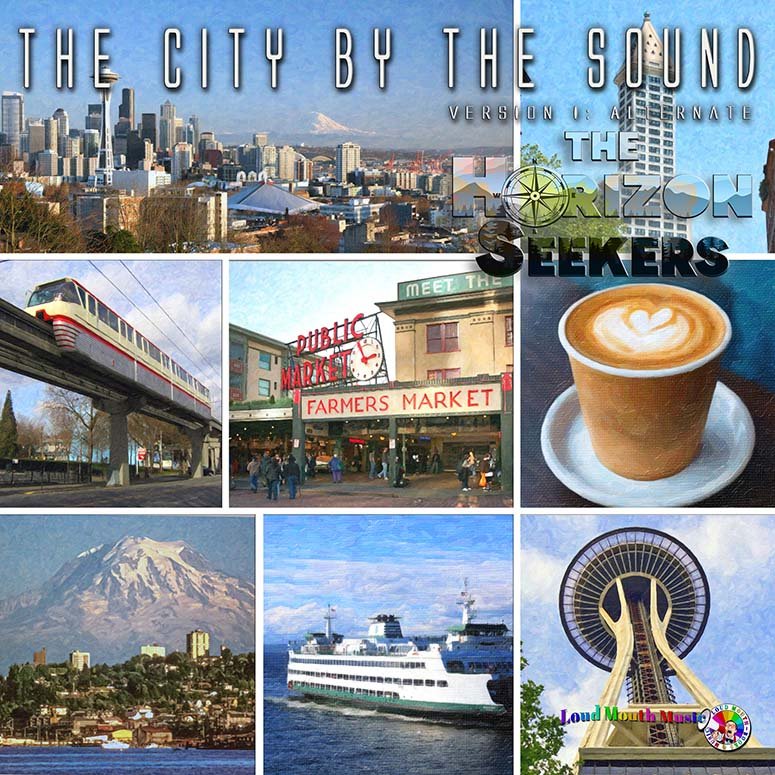
The story behind the song is Seattle told honestly, underneath the postcard. I wanted a civic anthem, but not a tourism brochure, so I wrote it in the voice of "we," the children of the Sound, born between the mountains and the shore. It rises like the Space Needle, but it also looks straight at the parts of the city that don't make the postcards.
That's where the contradictions come in. There are homeless hopes under the viaducts and startup millionaires in the glass towers, and the song puts them in the same verse on purpose, all drinking from the same cup, all breathing the same misty air. I traced the city's whole arc through it too, tech empires rising from the old lumber yards, grunge ghosts still haunting Pioneer Square, and an underground city with its secrets sleeping in stone. "Rust in our veins, but thunder in our hearts" is the line that holds it together for me, the industrial past and the emotional force that keeps the place moving.
I didn't want to pretend Seattle has solved anything. The refrain is "rain keeps falling, we keep rising," and I meant the rain as more than weather. It's the pressure, the inequality, the hard days, and the rising is what the people do anyway. I love the city precisely because it's beautiful and troubled at once, and I wanted a song big enough to hold both.
Anthemic alternative rock / grunge-influenced heartland rock.
Civic identity and belonging, contradiction and inequality, reinvention across eras, and resilience against hardship.
Primary Subject:
Seattle's identity, contradictions, and resilience, from the viaducts to the glass towers.
Mood:
Bold, gritty, defiant, and stirring.
Seattle is beautiful and troubled at once, and its real strength is the way its people keep rising, through inequality, change, and hard weather, without pretending the storms have stopped.
[Verse 1]
Neon reflects off rain-slicked streets
While ferries cut through evening mist
Coffee steam rises up like spirits
Into a steel and glassy sky
We are the children of the Sound
Born between the mountains and the shore
[Chorus]
We rise like the Space Needle
…piercing the clouds
Breaking through a steel-grey sky
Rust in our veins…
…but thunder in our hearts
This is our city…
…the city by the Sound
This is our city…
… the city by the Sound
[Verse 2]
Pike Place echoes with ancient voices
Market stalls overflow with stories untold
Beneath the underground city
Secrets sleep in stone
While seaplanes paint silver trails
Across pewter skies
[Chorus]
We rise like the Space Needle
…piercing the clouds
Breaking through a steel-grey sky
Rust in our veins…
…but thunder in our hearts
This is our city…
…the city by the Sound
This is our city…
… the city by the Sound
[Bridge: builds tension]
From Mount Rainier to the Olympic peaks
Giants watching over everything we've built
Every raindrop carries promises
Every wave along the shore
…brings change
(We are the change)
[Verse 3]
Homeless hopes under viaducts
Mix with startup millionaires
All drinking from the same cup
All breathing this misty air
While evergreens stand sentinel
Over gutters and hills
[Verse 4]
Tech empires rise from lumber yards
Grunge ghosts haunt Pioneer Square
We're building futures in coffee shops
Coaxing dreams and money from thin air
We are evolving, a city that never sleeps
Sleepless in Seattle…
…with rain-soaked streets.
[Chorus]
We rise like the Space Needle
…piercing the clouds
Breaking through a steel-grey sky
Rust in our veins…
…but thunder in our hearts
This is our city…
…the city by the Sound
This is our city…
… the city by the Sound
[Outro: Fade to atmospheric instrumental]
Rain keeps falling
We keep rising
Rain keeps falling
We keep rising...
"The City By The Sound" is a powerful, modern anthem about Seattle's identity, contradictions, resilience, and continual reinvention. Rather than presenting the city only through scenic landmarks and postcard beauty, the song looks beneath the rain-polished surface to explore its history, ambition, inequality, creativity, industry, and collective spirit. Seattle becomes a living character shaped by mountains and water, lumber and steel, grunge and technology, old marketplaces and new fortunes.
The song is written from a communal perspective. The repeated use of "we," "our," and "this is our city" gives it the character of a civic anthem rather than a visitor's travelogue. Its narrators are "the children of the Sound," people whose lives and identities have been formed between mountains, shorelines, rain, working waterfronts, neighborhoods, and a rapidly changing skyline. The song speaks for longtime residents, workers, artists, newcomers, entrepreneurs, and people struggling to find a place within the city.
The opening verse immediately establishes Seattle's nocturnal atmosphere. Neon light reflects from rain-slicked streets while ferries move through the evening mist. These images unite the city's urban and maritime identities. The neon belongs to streets, storefronts, and nightlife, while the ferries represent movement across Puget Sound and the daily connection between Seattle and the surrounding communities.
Coffee steam rising "like spirits" adds a ghostly and distinctly Seattle quality to the scene. The steam drifts into a sky of steel and glass, linking the intimate warmth of a café with the hard surfaces of the modern skyline. Coffee is treated as more than a regional habit. It becomes part of the city's social and creative bloodstream, rising from spaces where conversations, ideas, relationships, and businesses begin.
The description of the sky as "steel and glassy" reflects both Seattle's weather and its architecture. Gray clouds mirror the metal, concrete, and reflective towers below. The city appears to have grown from the same cool tones as the atmosphere surrounding it. Yet the imagery does not make Seattle feel lifeless. It creates a setting in which human warmth, creativity, and determination become more visible against the cold backdrop.
The final lines of the verse define Seattle geographically and emotionally. Its people are born "between the mountains and the shore," placing them within a landscape of opposing forces. The mountains represent permanence, challenge, wilderness, and aspiration. The shore represents movement, trade, migration, uncertainty, and openness. Seattle's identity develops between these two worlds.
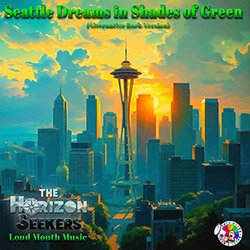
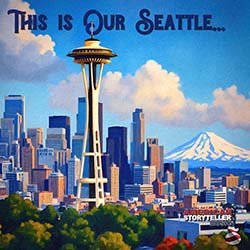
The chorus transforms the Space Needle into a symbol of collective resilience. The people of Seattle rise like the landmark itself, piercing clouds and breaking through a steel-gray sky. The image is both architectural and aspirational. The Space Needle does not merely decorate the skyline. It represents the ability to imagine something new and construct it in a difficult environment.
The phrase "rust in our veins" connects Seattle to its industrial and maritime past. Rust suggests shipyards, railroads, bridges, warehouses, machinery, lumber mills, docks, and working-class labor. It also acknowledges aging infrastructure and the weathered surfaces of a city shaped by moisture and salt air. The image gives Seattle's people an inherited toughness rooted in physical work and industrial history.
That industrial inheritance is immediately contrasted with "thunder in our hearts." Rust may exist in the city's structures and history, but its emotional force remains powerful. Thunder suggests defiance, energy, music, protest, storms, and the determination to keep moving forward. Together, rust and thunder express the song's central idea: Seattle carries the marks of its past while refusing to remain fixed within it.
The repetition of "This is our city" functions as a declaration of belonging. It is not simply pride in a skyline or collection of attractions. It is an assertion that the city belongs to the people who live, work, struggle, create, and dream there. The repeated phrase gives the chorus the force of a chant that could be sung by a crowd.
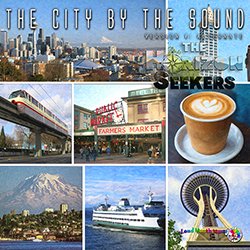
The second verse moves into Pike Place Market, where the voices of the past seem to remain present. The market is portrayed as a repository of human experience. Its stalls do not merely hold produce, flowers, seafood, and crafts. They overflow with stories belonging to vendors, fishermen, immigrants, workers, tourists, musicians, and generations of residents.
The phrase "ancient voices" gives the market a sense of depth extending beyond its visible activity. It suggests that Seattle's present is built upon layers of earlier communities and histories. Every transaction, performance, and conversation takes place within a setting that has witnessed decades of change.
The song then descends beneath the modern city into Seattle's underground passageways. The "secrets" sleeping in stone evoke the remains of streets, storefronts, and structures left behind after the city rebuilt itself at a higher level. This image reinforces the idea that Seattle has repeatedly remade itself without entirely erasing what came before.
Stone becomes a vessel for memory. Beneath the sidewalks and towers, an earlier Seattle remains hidden. The lyric suggests that the city's past is never truly gone. It exists beneath contemporary life, influencing the present even when it cannot be seen.
Above this buried history, seaplanes create silver trails across pewter skies. The movement from underground stone to aircraft overhead gives the verse a strong vertical dimension. Seattle extends downward into forgotten passages and upward into open air. The seaplanes also connect the city to lakes, islands, remote communities, and the wider Pacific Northwest.
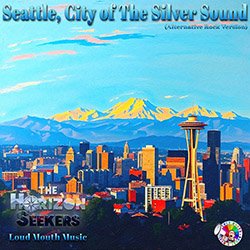
The bridge expands the setting beyond the streets to the immense landscape surrounding Seattle. Mount Rainier and the Olympic Mountains are described as giants watching over everything the city has built. Their scale places human achievement in perspective. Skyscrapers, bridges, companies, and neighborhoods may be impressive, but they exist beneath ancient mountains that dominate the horizon.
The mountains serve as witnesses to Seattle's development. They have watched the transformation from Indigenous homelands and natural shorelines to ports, lumber mills, railways, industrial districts, residential neighborhoods, and technology centers. Their presence gives the city both grandeur and humility.
The statement that every raindrop carries promises transforms Seattle's most familiar weather into a symbol of renewal. Rain can be monotonous, cold, and difficult, but it also sustains the region's forests, rivers, and green spaces. In the context of the song, each drop represents possibility, endurance, and the belief that change can emerge from difficult conditions.
The waves along the shore bring change in a similar way. Tides continually reshape the boundary between land and water, making them a natural metaphor for Seattle's evolving identity. The response "We are the change" shifts responsibility from the landscape to the people. Seattle does not transform by accident. Its residents participate in shaping what it becomes.
Verse three introduces the song's most direct social contrast. "Homeless hopes under viaducts" exist beside startup millionaires. The line acknowledges that Seattle's growth and wealth have not benefited everyone equally. The city's reputation for innovation and prosperity exists alongside visible homelessness, displacement, economic insecurity, and people living beneath the infrastructure of urban progress.
The use of "hopes" instead of simply "homeless people" preserves the humanity of those being described. They are not reduced to a social problem. They possess ambitions, fears, histories, and dreams, even when forced to live under bridges or viaducts.
The startup millionaires represent Seattle's newer economy of technology, investment, entrepreneurship, and rapid wealth creation. Placing them in the same verse as people experiencing homelessness forces the listener to confront the extreme differences contained within the same city.
The line "All drinking from the same cup" suggests shared dependence, vulnerability, and belonging. Despite enormous differences in wealth and status, everyone relies upon the same environment and civic community. They breathe the same misty air, experience the same rain, and move through the same streets.
The cup may also refer to coffee, one of the song's recurring Seattle symbols. A person with almost nothing and a wealthy entrepreneur may both seek warmth or conversation in a café. The image does not erase inequality, but it emphasizes common humanity beneath social divisions.
The evergreens standing sentinel over gutters and hills create another important contrast. Evergreen trees usually symbolize beauty, wilderness, and endurance, but here they watch over both elevated neighborhoods and the neglected spaces along the streets. Nature does not distinguish between wealth and poverty. The trees stand over the whole city.
The mention of gutters grounds the song in the less glamorous realities of urban life. Rainwater, debris, pavement, tents, towers, gardens, and wooded hills all occupy the same environment. Seattle's beauty and hardship are not separate stories. They exist side by side.
Verse four traces the city's economic and cultural evolution. "Tech empires rise from lumber yards" condenses more than a century of transformation into a single striking line. Seattle's earlier prosperity was tied heavily to timber, shipping, manufacturing, fishing, railroads, and maritime trade. Its newer global influence is associated with software, aerospace, online commerce, biotechnology, and digital innovation.
The word "empires" conveys the enormous reach and power of Seattle-based technology companies. Yet connecting them to lumber yards reminds the listener that each new economy grows from the physical and historical foundations of the old one. The modern city has not appeared from nowhere.
The "grunge ghosts" haunting Pioneer Square connect Seattle's artistic identity with its streets and historic neighborhoods. Grunge represents disaffection, honesty, distorted guitars, working-class clothing, underground venues, and a rejection of polished commercial expectations. By describing its figures and memories as ghosts, the song suggests that the movement continues to influence Seattle even after its defining era has passed.
Pioneer Square is a fitting location for these ghosts because it holds multiple layers of Seattle history. Its brick buildings, alleys, music venues, art spaces, and underground passages create an atmosphere where the city's past remains close to the surface.
The line about building futures in coffee shops captures Seattle's reputation as a place where large ideas can begin in small, informal settings. Coffeehouses become offices, studios, meeting rooms, and creative laboratories. Artists write songs, programmers develop concepts, entrepreneurs sketch business plans, and strangers exchange ideas across small tables.
"Coaxing dreams and money from thin air" has a deliberately ambiguous tone. It celebrates imagination and invention, but it may also question the speculative quality of modern wealth. Digital products, startup valuations, intellectual property, and online economies can create fortunes from things that seem intangible. The line captures both the wonder and unreality of that process.
The declaration that Seattle is "evolving" reinforces the song's refusal to portray the city as static. It is always becoming something else. Industries rise and decline, neighborhoods change, cultures meet, and new residents reshape the civic landscape.
The phrase "a city that never sleeps" is then adapted into "Sleepless in Seattle," adding a familiar cultural reference while giving it a broader meaning. The sleeplessness is not only romantic. It belongs to workers, musicians, entrepreneurs, unhoused residents, night-shift employees, travelers, and anyone kept awake by anxiety, ambition, weather, or possibility.
The rain-soaked streets return at the end of the verse, bringing the song full circle. Rain remains the constant element running through every stage of Seattle's history. Industries change, buildings rise, music scenes fade, and fortunes appear, but the rain continues to fall across the city.
The final chorus gains greater meaning after the social and historical complexities of the later verses. Rising through the clouds now represents more than civic pride. It signifies the effort to overcome inequality, hardship, economic change, and the weight of history.
The song does not claim that Seattle has solved its problems. Instead, it celebrates the city's capacity to confront contradiction and keep moving. The thunder in its heart comes from workers, artists, activists, dreamers, immigrants, innovators, and residents who refuse to let the city's story be controlled by any one industry or social class.
The outro reduces the song to two repeated statements: "Rain keeps falling" and "We keep rising." This is the song's essential message. The rain represents hardship, pressure, sorrow, criticism, uncertainty, and the environmental conditions that define the city. Rising represents persistence, growth, resistance, creativity, and hope.
The repetition creates the impression that both forces will continue indefinitely. Seattle will always face storms, whether meteorological, economic, social, or cultural. Its people will continue responding by rebuilding, creating, organizing, and imagining something new.
Structurally, "The City By The Sound" develops from atmosphere into civic identity, history, social commentary, and cultural evolution. The first verse establishes the physical city. The second explores memory and hidden history. The bridge connects the urban world to the surrounding mountains and water. The third confronts inequality, while the fourth follows Seattle's transformation from industrial center to cultural and technological powerhouse.
This progression gives the song the depth of a modern city portrait. It is affectionate without becoming sentimental and proud without ignoring difficult realities. Seattle is celebrated precisely because it contains contradictions rather than because it is presented as perfect.
Musically, the song would work especially well as an anthemic alternative rock, cinematic grunge-influenced rock, heartland rock, or modern adult contemporary production. The opening could begin with rain ambience, distant ferry horns, a low synthesizer drone, or clean electric guitar notes coated in reverb.
The first verse could remain controlled and atmospheric, with steady bass and restrained percussion beneath the vocal. The chorus should expand dramatically with distorted guitars, powerful drums, layered backing vocals, and a rising melodic line on "We rise like the Space Needle."
The pauses and ellipses within the chorus invite a dramatic vocal delivery. "Rust in our veins" could be sung over reduced instrumentation before the full band returns on "but thunder in our hearts." This contrast would emphasize the movement from industrial weight to emotional power.
The second verse could introduce subtle metallic percussion or textured sounds that suggest market stalls, underground passageways, seaplanes, and old infrastructure. The bridge should gradually build tension with tom drums, sustained strings, guitar feedback, or rising synthesizers before breaking open on "We are the change."
Verse three may benefit from a more exposed arrangement that allows the social commentary to remain clear. A lower vocal register, sparse piano, or subdued guitar could make the contrast between homelessness and wealth feel more immediate.
Verse four could reintroduce stronger rhythm and distorted guitar, especially around the references to technology, grunge, and Pioneer Square. The final chorus should feel larger than the earlier repetitions, potentially including a crowd-style vocal on "This is our city."
The outro could strip the arrangement back gradually while the phrases "Rain keeps falling" and "We keep rising" repeat over atmospheric guitars, distant thunder, and the sound of rainfall. The final instrumental fade would leave the impression that the city's story continues beyond the song.
At its core, "The City By The Sound" is about belonging to a city that is beautiful, troubled, ambitious, historic, unequal, creative, and impossible to reduce to a single image. It recognizes Seattle's famous landmarks and natural setting while also confronting the lives unfolding beneath them.
The result is a bold civic anthem with a strong sense of place and social awareness. It presents Seattle as a city built from timber, steel, water, music, technology, memory, and human determination. Rain keeps falling across its streets, but its people continue to rise.











.jpg)