"Southwest Portals©"
Lyrics by M. S. McKenzie (Unless Otherwise Noted) | Music Performed by Songs Across America or American Storyteller Music, All Songs Are Protected by Copyright
~ Associated State Links ~
"Southwest Portals"
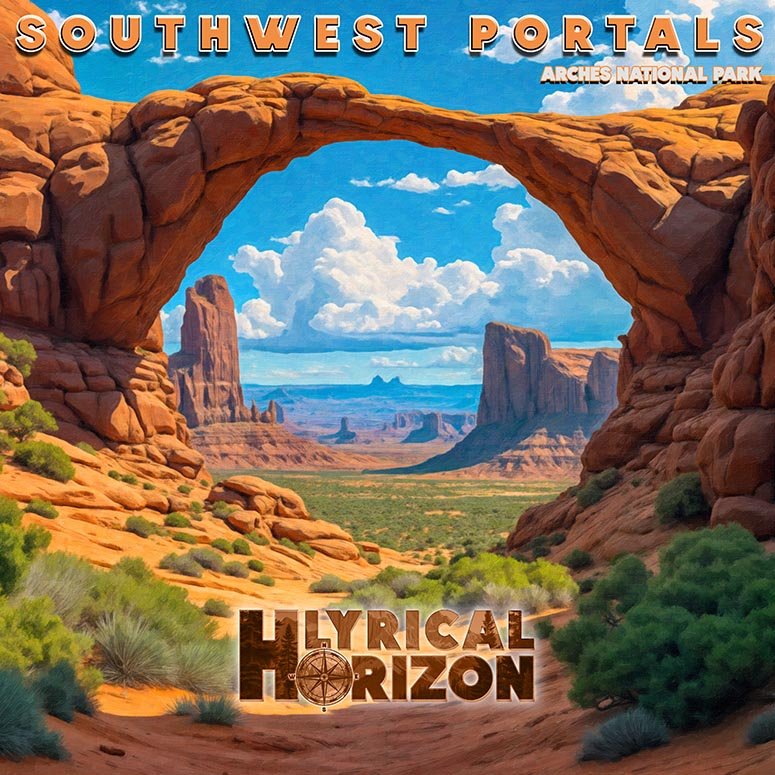
The story behind the song is really the story of standing under an arch and understanding that I was looking through a doorway. That's where the title came from. The arches of southeastern Utah frame the La Sal Mountains, the desert sky, the moon, but they also open onto something bigger, the whole slow history of salt and sandstone and erosion that made them. I wanted every verse to feel like stepping through one more portal into deeper time.
The heart of the song, though, is the line "we are visitors to this frontier." The more I looked at those balanced rocks and delicate spans, the more I felt how fragile they really are underneath their apparent permanence. Landscape Arch has already dropped rock in our own lifetimes. What took thousands of years to form can vanish in a moment, and a lot of that loss now comes from careless hands. So the song keeps turning from wonder toward responsibility.
I didn't want it to be a lecture, though. I wanted it to feel like awe first and stewardship second, the way it actually happens when you're out there. You stand above Fin Canyon, you feel how brief your own time is against the earth's, and the care comes naturally. We didn't make these places, and we can't promise they'll last, but we can decide how gently we walk through them and what we leave for the people who come after.
Cinematic Southwestern folk-rock / conservation anthem with layered vocals.
Wonder and fragility, conservation and stewardship, deep time against human brevity, and reverence for wild places.
Primary Subject:
Arches National Park and the red-rock country of southeastern Utah.
Mood:
Reverent, expansive, humbled, and protective.
The desert's arches are portals into deep time, and the awe they inspire carries a duty to tread lightly and protect what we cannot replace.
[Verse 1:]
Red rock pinnacles reach for the sky
Stone windows carved by wind and time
A rare condor floats on zephyrs highs
While wondrous arches appear sublime
Framing La Sal peaks, covered in snow
Two thousand arches mark this domain
Where balanced rocks put on a show
And mountain lions defend their reign
[Chorus: Layered Vocals]
Standing here in the Garden of Eden
Where sandstone towers touch the sky
In showy colors of orange and vermillion
Sacred canyons where bald eagles fly
Above secret treasures carved in stone
We humans must tread lightly here
Preserving this place to be left alone
For we are visitors to this frontier
[Verse 2:]
Delicate Arch in the sunset, glows
Like frozen fire against a crimson sky
Double 'O' Arch stands guard below
Amidst Devil's Garden pathways find
As a full moon rises over Dome Plateau
Where red-rock fins hide hidden arches
Like Pine Tree, Landscape and Navaho
Formations hold their own uniqueness
[Bridge:]
But these monuments of stone
Seem so eternal in our eyes
Are as fragile as the desert rain
Beneath these Western skies
We must tread with gentle steps
Through this sacred space
What took thousands of years to form
Could vanish without a trace
[Verse 3:]
From Windows Section to the Fins
Through canyons deep and wide
The desert blooms in shadowed spots
Where precious waters hide
Courthouse Towers in lofty heights
Where thunder and lightning rule
While ancient pictographs remain
To show what the Ancients already knew
[Verse 4:]
Stand proud above Fin Canyon
Let nature's wonder be your guide
In this grand sandstone dominion
Where the earth and sky collide
For our time here is very brief
Compared to Earth's eternal flow
Guardians of this ancient reef
That future days must know
[Chorus: Layered Vocals]
Standing here in the Garden of Eden
Where sandstone towers touch the sky
In showy colors of orange and vermillion
Sacred canyons where bald eagles fly
Above secret treasures carved in stone
We humans must tread lightly here
Preserving this place to be left alone
For we are visitors to this frontier
"Southwest Portals" is a sweeping cinematic folk-rock tribute to the sandstone arches, fins, towers, canyons, desert wildlife, and fragile ecosystems of Arches National Park and the surrounding red-rock country of southeastern Utah. Through images of Delicate Arch at sunset, the snow-covered La Sal Mountains, Devil's Garden, the Windows Section, Courthouse Towers, hidden desert water, and ancient rock art, the song presents the landscape as a series of natural gateways into deep time.
The title captures the defining visual and symbolic idea of the song. The arches are literal portals, creating openings through walls and fins of sandstone and framing distant mountains, desert skies, moonlight, and changing weather. Yet they are also portals into the history of the Earth. Each opening reveals the work of ancient sediments, underground salt movement, uplift, cracking, frost, wind, water, gravity, and erosion.
The title's use of "Southwest" broadens the meaning beyond one park. Although the lyrics are centered primarily on Arches National Park, the song evokes the larger Colorado Plateau, where sculpted sandstone, isolated mesas, deep canyons, sacred cultural landscapes, and enormous skies define much of southern Utah and the surrounding region.
The song's central message is one of reverence and restraint. These stone formations may appear permanent, but they are continually changing and can be damaged by careless human activity. The repeated declaration that "we are visitors to this frontier" asks listeners to enter the landscape humbly, recognizing that human lives are brief compared with the geological processes that created it.
The first verse opens with red-rock pinnacles reaching toward the sky. Their vertical forms immediately establish the dramatic scale of the landscape and give the formations an almost aspirational quality. The stone appears to stretch upward, connecting the desert floor with the open blue above it.
"Stone windows carved by wind and time" introduces the song's portal imagery. The arches and openings resemble windows deliberately cut into enormous walls, even though they arose through natural erosion rather than human design.
Wind contributes to the weathering of exposed surfaces, but water, freezing and thawing, fractures, and gravity are also essential to the formation and eventual collapse of arches. Within the lyric, wind and time act as poetic sculptors, slowly removing weaker material and leaving improbable openings behind.
The rare condor floating on high breezes adds a majestic wildlife image. The enormous bird appears almost suspended above the formations, gliding without visible effort through rising air.
The phrase "zephyrs highs" would read more naturally as "zephyrs high" or "on zephyrs rising high." The intended image is clear: the bird rides gentle desert winds above the stone.
A geographical note may be useful if strict accuracy is important. California condors are associated with parts of the broader Colorado Plateau and have been reintroduced in northern Arizona and southern Utah, but they are not among the most routinely encountered birds within Arches itself. As a poetic image of Southwestern conservation and rare wildlife, however, the condor fits the song's expansive regional perspective.
The arches are described as sublime, a word that captures beauty mixed with awe. Their size, isolation, and precarious appearance make them more than attractive formations. They inspire an awareness of forces and timescales beyond normal human experience.
The La Sal Mountains rise in the distance, often retaining snow when the desert below is warm and dry. Their white summits provide a striking visual contrast with the orange and red sandstone foreground.
Arches framing the La Sals create one of southeastern Utah's most memorable compositions. The natural opening becomes a picture frame, drawing together two different environments: high mountains and exposed desert.
The reference to approximately two thousand arches emphasizes the concentration of natural openings within the park. The landscape is not defined by one isolated formation but by a vast collection of arches, windows, bridges, fins, towers, and balanced stones, each at a different stage of development.
Balanced rocks "put on a show" by appearing to defy ordinary expectations. Their massive upper stones rest upon narrower pedestals, creating the impression that gravity has somehow been suspended.
These formations also reinforce the song's conservation theme. They appear stable when viewed during a human lifetime, yet they are temporary features within the longer process of erosion.
The mountain lions defending their realm bring a hidden and powerful predator into the verse. They are rarely seen, but their possible presence reminds visitors that the park is not an empty geological museum. It is a living habitat where wildlife continues moving beyond the reach of most human observation.
The chorus begins in the Garden of Eden, one of the named areas within Arches National Park. The name gives the scene both geographic specificity and symbolic weight. The narrator appears to be standing in a desert paradise formed not from lush vegetation but from towering sandstone and radiant color.
"Where sandstone towers touch the sky" creates a visual connection between geology and the heavens. The formations become natural monuments, rising with the scale and dignity of architecture.
The orange and vermilion colors intensify the scene. These tones shift throughout the day, becoming pale beneath harsh midday light and deepening dramatically during sunrise, sunset, and approaching storms.
The word "showy" acknowledges that the landscape can be visually extravagant. Although the desert may initially seem sparse, its stone is anything but plain. Light reveals layers of orange, red, gold, cream, and shadow.
The sacred canyons introduce a spiritual dimension. Sacredness here can be understood ecologically, culturally, emotionally, or religiously. The canyons inspire reverence because of their beauty and age, but they may also carry profound meaning for Indigenous peoples whose relationships with this region extend far beyond modern park boundaries.
Bald eagles flying above the canyons add another symbol of freedom, strength, and wildness. Their presence reinforces the vertical nature of the chorus, with human visitors below, stone towers rising around them, and birds moving through the sky above.
The "secret treasures carved in stone" refer to arches, hidden openings, rock art, narrow passages, fossil traces, mineral patterns, and formations not immediately visible from roads or overlooks.
The word "secret" suggests that the desert rewards patient exploration. Some of its greatest features appear only after following a trail, rounding a fin, entering a canyon, or waiting for the light to change.
The chorus then shifts from admiration to responsibility. "We humans must tread lightly here" is the song's clearest ethical statement. It asks visitors to minimize damage, respect wildlife, remain on appropriate routes, leave cultural resources untouched, and avoid treating the landscape as a disposable stage for recreation.
"Preserving this place to be left alone" expresses the desire to protect the desert from excessive intrusion. The wording does not necessarily require complete human exclusion. Rather, it suggests leaving the essential character of the place undisturbed.
The line "For we are visitors to this frontier" places humans in a temporary role. The desert does not belong exclusively to the people passing through it. Wildlife, ancestral histories, geological processes, and future generations also have claims upon its continued existence.
The second verse turns toward several of the park's best-known formations. Delicate Arch glows at sunset like frozen fire, combining the imagery of heat and stillness.
The arch's sandstone intensifies under low-angle light, making it appear illuminated from within. "Frozen fire" captures both its vivid color and its arrested movement. The stone seems to preserve the energy of ancient geological forces in a solid form.
The crimson sky expands that fire imagery across the entire horizon. Arch and atmosphere briefly share the same palette, blending Earth and sky.
Double O Arch then appears within Devil's Garden. Its paired openings create one of the song's clearest examples of the portal theme, with one window positioned above another.
The phrase "Amidst Devil's Garden pathways find" is incomplete grammatically. A smoother version might be:
"Along the Devil's Garden paths we find"
or:
"Where Devil's Garden pathways wind."
The second option fits the setting especially well and creates a natural transition into the following imagery.
The full moon over Dome Plateau introduces a nocturnal desert scene. Moonlight removes much of the daytime color while strengthening outline, shadow, and silence.
Under a full moon, the plateau and sandstone formations may feel more mysterious and monumental. Openings become dark windows, and the desert appears suspended between familiar geography and dream.
The red-rock fins hiding arches describe an important stage in their formation. Long, narrow walls of sandstone fracture and erode until openings gradually form within them.
The fins therefore conceal future arches as well as existing ones. Some openings are obvious, while others remain tucked among parallel walls and narrow passages.
Pine Tree, Landscape, and Navajo arches are presented as individual formations with distinct identities. The spelling would normally be "Navajo Arch," rather than "Navaho."
Landscape Arch is especially appropriate to the song's fragility theme. Its long, remarkably thin span appears almost impossible, and the fall of rock from its underside in modern times demonstrated that major geological change continues within the park.
The declaration that each formation holds its own uniqueness prevents the landscape from becoming a repetitive catalog of holes in rock. Every arch differs in shape, scale, orientation, location, color, and relationship with the surrounding terrain.
The bridge provides the song's philosophical center. The stone monuments seem eternal when measured against human lives, but that appearance is misleading.
People may visit the same arch decades apart and see little change, leading them to imagine it as permanent. Geological time tells a different story. Every arch is temporary.
The comparison with desert rain emphasizes fragility through contrast. Rain may be brief and infrequent, yet it contributes to the processes that weather and reshape the stone.
The formations are strong enough to survive storms and centuries, but vulnerable enough to crack, shed rock, or collapse without warning. Strength and fragility coexist.
"We must tread with gentle steps" turns the conservation message into a physical instruction. The visitor's behavior should reflect awareness of delicate biological soil crusts, sparse vegetation, unstable surfaces, cultural sites, and wildlife habitat.
The term "sacred space" deepens the ethical demand. One behaves differently in a place considered sacred. Noise, carelessness, vandalism, and entitlement become forms of disrespect.
"What took thousands of years to form / Could vanish without a trace" expresses the imbalance between creation and destruction. Natural formations develop slowly, but human damage can occur within seconds.
Some arches will also disappear through natural erosion. The song does not ask humans to stop geological change, which would be impossible. It asks them not to accelerate loss through negligence.
The third verse moves through the Windows Section, sandstone fins, deep canyons, desert vegetation, and the monumental Courthouse Towers.
The Windows Section contains several large openings that allow visitors to experience the portal concept directly. Standing beneath or beyond them, a person sees sky, cliffs, and distant desert framed within stone.
The fins again create narrow corridors and parallel walls. Moving among them can feel like entering a city or maze built from rock.
The desert blooming in shaded locations reveals the importance of small differences in moisture and temperature. A protected recess, seep, canyon floor, or shadowed wall may support vegetation absent from more exposed ground.
"Where precious waters hide" acknowledges the scarcity of water. Springs, pools, temporary streams, and moisture held within soil or rock can determine where plants, animals, and people survive.
Water is especially precious because it is both limited and creative. The same element required by every living organism also participates in carving arches and canyons.
Courthouse Towers rise with the commanding appearance of civic or ceremonial buildings. Their name reinforces the landscape's resemblance to a monumental human city, though the formations were shaped entirely by natural processes.
Thunder and lightning ruling above them introduce sudden desert weather. Storms can transform the atmosphere rapidly, darkening the sandstone, illuminating towers, and sending water through normally dry channels.
The line about ancient pictographs acknowledges the human history preserved within the region. Rock imagery provides evidence of earlier peoples who traveled through, lived within, and understood these desert landscapes.
The phrase "what the Ancients already knew" suggests that earlier communities possessed knowledge modern visitors often lack: the locations of water, seasonal weather, animal behavior, routes through difficult terrain, and the cultural or spiritual meaning of particular places.
It is important to avoid implying that these peoples disappeared without descendants. Their knowledge and cultural relationships continue through living Indigenous nations connected to the broader region.
The fourth verse asks the listener to stand above Fin Canyon and allow nature to become a guide. The elevated viewpoint creates both physical and philosophical perspective.
The "sandstone dominion" presents the region as a kingdom ruled by stone, weather, and geological time rather than by human authority.
"Where the earth and sky collide" describes the sharp visual boundary created by fins, towers, and mesas against open atmosphere. It also suggests the emotional experience of standing within a place where terrestrial and celestial scales seem to meet.
The recognition that human time is brief introduces humility. Individual lives occupy only the smallest interval compared with the formation and eventual destruction of the landscape.
"Earth's eternal flow" describes the planet as continuously changing. Although the word "eternal" may suggest permanence, the line's deeper meaning lies in uninterrupted process. Rock rises, fractures, erodes, falls, and becomes sediment again.
The visitors become "guardians of this ancient reef." The phrase "reef" may refer poetically to the crowded fins and towers, which can resemble a stone reef rising from the desert.
Geologically, however, Arches is not generally described as an ancient coral reef landscape. The formations developed primarily in sandstone layers influenced by the movement and collapse of underlying salt deposits, followed by erosion. As metaphor, "ancient reef" conveys a labyrinth of stone formations rising from an open plain.
Calling humans guardians changes their role from consumers of scenery to temporary stewards. Guardianship does not mean ownership. It means accepting responsibility during the brief period in which the landscape has been entrusted to the present generation.
"That future days must know" refers to future people who deserve the chance to experience the same arches, silence, wildlife, darkness, and open horizons.
The repeated final chorus gathers the song's visual and ethical themes into one statement. The Garden of Eden remains brilliant and beautiful, but its meaning now includes everything learned about fragility.
The towers still touch the sky and eagles continue flying, yet the visitor understands that admiration alone is insufficient. Love of a place must be expressed through conduct.
Musically, "Southwest Portals" would work especially well as cinematic Southwestern folk-rock, atmospheric Americana, or a broad conservation anthem. The arrangement should convey wonder, openness, and gradual emotional expansion.
The song could begin with acoustic guitar, low strings, and a distant electric-guitar line suggesting wind across the sandstone. Sparse percussion would preserve the feeling of open space.
The first verse should feel exploratory. The instrumentation might gradually widen as condors, arches, the La Sal Mountains, and balanced rocks enter the scene.
The chorus calls for layered vocals, as indicated. Separate harmony lines could enter on "Garden of Eden," "sandstone towers," and "we are visitors," creating the impression of voices echoing among the formations.
The first half of the chorus should sound expansive and luminous, while the conservation lines should become more grounded and solemn. A slight harmonic change beneath "we humans must tread lightly here" would emphasize the shift from celebration to responsibility.
The second verse could introduce a warmer sunset palette through strings, mandolin, or clean electric guitar. The full-moon image might be supported by a temporary thinning of the rhythm section and the entrance of atmospheric keyboard tones.
The bridge should begin quietly, perhaps with voice and piano or acoustic guitar, allowing the apparent permanence of the formations to stand against their actual vulnerability.
Percussion and low strings could build beneath "We must tread with gentle steps," transforming the bridge into a conservation pledge.
The third verse could regain momentum through steady drums and rhythmic acoustic guitar. Brief instrumental openings might accompany the Window Section, thunderstorms, and ancient pictographs.
The fourth verse should feel elevated and reflective. Strings or electric guitar could climb melodically as the narrator stands above Fin Canyon and considers humanity's brief place within Earth's history.
The final chorus should be the broadest section, with full harmony vocals, drums, strings, and sustained guitar. Despite its musical scale, the performance should remain reverent rather than triumphant.
An instrumental outro could repeat the portal-like melodic theme as the arrangement gradually fades. Wind ambience or a single sustained guitar note might remain after the other instruments disappear, suggesting the desert continuing in silence.
At its heart, "Southwest Portals" is a song about entering a landscape while recognizing that it does not belong to us. The arches frame extraordinary views, but they also frame a different understanding of time.
Human lives are brief. The stone appears old and permanent, yet it too is temporary. The contrast creates humility.
The song also challenges the notion that national parks are simply collections of attractions. The arches, canyons, water sources, wildlife habitats, and cultural sites form an interconnected environment whose value cannot be reduced to photographs or landmarks.
The repeated language of sacredness does not remove people from the landscape. It asks them to enter with care. Visitors may hike, observe, learn, and experience wonder, but they should resist the assumption that access grants entitlement.
"Southwest Portals" is therefore both a celebration of Arches National Park and a stewardship song. Its arches become openings into beauty, geology, ancestry, fragility, and responsibility.
Its deepest message is that every generation passes briefly through these portals. We do not create them, and we cannot guarantee their permanence. What we can control is the manner in which we enter, the traces we leave behind, and whether those who come after us will still find a wild desert waiting beyond the stone.










.jpg)