"Golden State of Mind©"
Lyrics by M. S. McKenzie (Unless Otherwise Noted) | Music Performed by Songs Across America or American Storyteller Music, All Songs Are Protected by Copyright
~ Associated State Links ~
"Golden State of Mind"
[Instrumental Intro]
[Verse 1]
Dappled light on the harbor tide
The sails unfurl and our dreams collide
Leaving Oxnard's peaceful shore
Searching horizons, wanting so much more
On a day so fair with an easy breeze
That whispers through the palm trees
I inhale the salt air deep within my soul
Feeling so alive, feeling so whole
[Chorus: rhythmic, layered vocals]
Oh, I'm living in a Golden State of Mind
Where the ocean breeze calls, and my spirit unwinds
Every wave and every shore
Makes me long to explore
I sail on hope and the freedom that I find
In this Golden State of Mind
[Verse 2]
Anacapa's light stands on a distant shore
Guiding me through nature's door
Arch Rock appears like Poseidon's Portal
And worlds collide—mortal and immortal
A thousand seabirds circle overhead
While dolphins play where man cannot tread
The Channel Islands hum the tune to a song
And for those who hear it, know that they belong
[Chorus: rhythmic, layered vocals]
Oh, I'm living in a Golden State of Mind
Where the ocean breeze calls, and my spirit unwinds
Every wave and every shore
Makes me long to explore
I sail on hope and the freedom that I find
In this Golden State of Mind
[Verse 3]
Drifting by Cavern Point's fair view
I wave to a kayaker or two
As they beach at Smugglers Cove
Where sea lions bask by the droves
Then we chart a course anew
For fair Catalina in a distant view
By sunset, Avalon Bay appears
A tranquil refuge draws near
[Bridge: Instrumental]
[Verse 4]
Whales slip in and out of the waves
Past sea stacks and rocks and ocean caves
I feel their spirit echo within mine
In these waters, both of us, divine
In the gentle hush of the fading day
My heart's compass points the way
To endless coasts I've yet to see
California wonders setting me free
[Chorus: rhythmic, layered vocals]
Oh, I'm living in a Golden State of Mind
Where the ocean breeze calls, and my spirit unwinds
Every wave and every shore
Makes me long to explore
I sail on hope and the freedom that I find
In this Golden State of Mind
[Outro: Instrumental]
Song Description
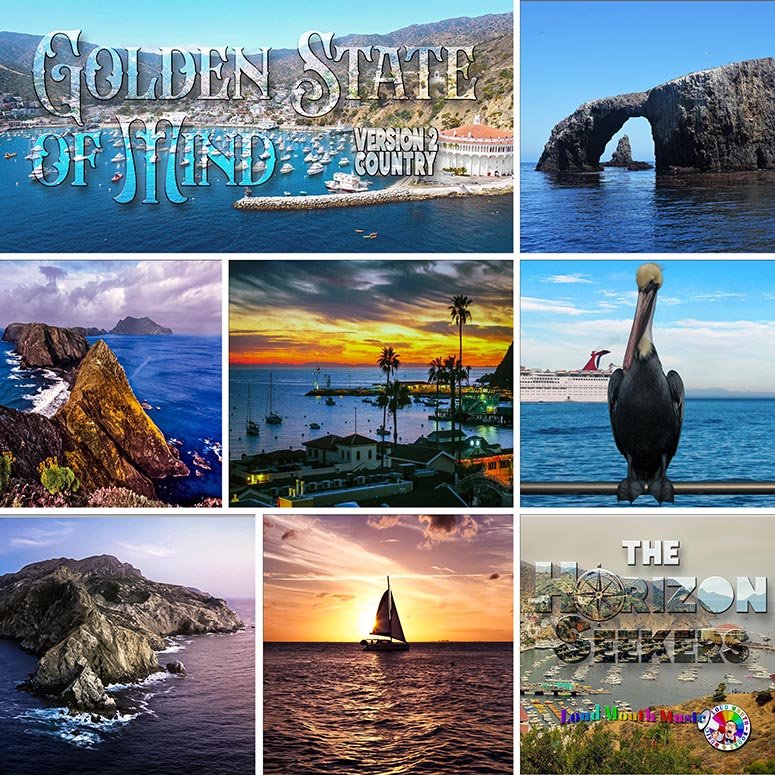
"Golden State of Mind" is a bright, cinematic California sailing song about freedom, exploration, belonging, and the emotional renewal that comes from being out on open water. Beginning in Oxnard and moving past Anacapa Island, the Channel Islands, Cavern Point, Smugglers Cove, and eventually toward Catalina and Avalon Bay, the song follows a traveler whose physical journey along the Southern California coast becomes an inward journey toward clarity, optimism, and a stronger sense of self.
The title is one of the song's greatest strengths because it works on several levels at once. "Golden State" immediately identifies California, but "Golden State of Mind" transforms the state's nickname into an emotional condition. California is not simply where the narrator happens to be. It becomes a way of feeling: open, adventurous, hopeful, energized, and receptive to possibility.
The phrase also suggests that geography can influence psychology. The ocean breeze, sunlight, islands, wildlife, and distant horizons combine to create a state of mind in which ordinary pressures loosen their hold. The narrator feels less confined and more connected to the world around him.
The song is therefore both a travel narrative and a celebration of the mental freedom associated with movement. Sailing becomes the ideal metaphor because it requires direction without complete control. The sailor chooses a course, but wind, weather, currents, distance, and circumstance remain part of the journey.
The instrumental introduction should establish that sense of movement before the first lyric appears. Acoustic guitar, clean electric guitar, light percussion, warm bass, and perhaps a subtle piano or saxophone line could create the feeling of a harbor gradually opening into the Pacific.
The music should feel buoyant rather than hurried. The listener should sense sails filling with wind, water moving gently against the hull, and the coastline beginning to recede.
The first verse opens with "Dappled light on the harbor tide," immediately creating a warm and impressionistic coastal image. Sunlight broken by rigging, boats, ripples, and passing clouds dances across the water.
The word "dappled" is particularly effective because it suggests movement. The light is not static. It flickers and shifts with the tide, establishing a visual rhythm that suits a song about sailing.
"The sails unfurl and our dreams collide" moves quickly from scenery into emotional purpose. The sails opening mark the true beginning of the journey, while the collision of dreams suggests shared excitement, overlapping ambitions, or the convergence of imagination and reality.
The use of "our" also gives the opening a communal quality. The narrator may be traveling with another person, a group, or simply speaking inclusively about everyone who has felt the call of the coast.
Leaving Oxnard's peaceful shore provides the song with a real departure point. Oxnard and the nearby Channel Islands Harbor area naturally connect the mainland with excursions toward the Channel Islands.
The shore is described as peaceful, which makes the decision to leave more meaningful. The narrator is not escaping obvious danger or misery. He is leaving comfort because he wants something larger.
"Searching horizons, wanting so much more" gives the song its emotional engine. The horizon symbolizes possibility precisely because it can never be fully reached. Every mile sailed reveals another horizon beyond it.
The narrator's desire for "more" is not presented as greed or dissatisfaction. It is curiosity. He wants more experience, more perspective, more beauty, and more connection with the world.
The fair weather and easy breeze reinforce the optimistic tone. Nature seems to cooperate with the journey, at least for the moment.
The breeze whispering through the palm trees creates a final connection to the mainland before the boat moves farther offshore. The sound of the palms becomes almost like a farewell.
The narrator then inhales the salt air deeply "within my soul," shifting from literal breath to emotional absorption. He does not simply smell the sea. He takes the entire experience inward.
The final lines, "Feeling so alive, feeling so whole," establish the song's central emotional transformation. Travel and open water restore something that everyday life may have diminished.
The narrator's wholeness comes from immersion in the present moment. Wind, water, light, motion, and expectation temporarily align.
The chorus transforms that feeling into the song's defining declaration:
"Oh, I'm living in a Golden State of Mind."
The word "living" is important. The Golden State of Mind is not a temporary fantasy or abstract idea. The narrator feels as though he is actively inhabiting it.
The rhythmic layered vocals specified for the chorus could make the title especially memorable. The main vocal could carry the phrase while backing voices repeat fragments such as "Golden State," "state of mind," or "freedom that I find."
The ocean breeze calling while the narrator's spirit unwinds establishes the connection between external landscape and internal release.
"Unwinds" suggests that he has arrived carrying tension, obligations, or mental clutter. The coast gradually loosens those knots.
The line "Every wave and every shore / Makes me long to explore" makes curiosity self-reinforcing. Each discovery does not satisfy the traveler completely. Instead, it creates desire for the next one.
This is one of the defining emotions of meaningful travel. Seeing something extraordinary often expands rather than reduces the list of places one wants to experience.
The phrase "I sail on hope" is especially strong because it transforms hope into the element carrying the vessel forward.
Technically, the boat sails on water and wind, but emotionally it sails on expectation, possibility, and trust in whatever lies beyond the current horizon.
"The freedom that I find" reveals that freedom is not necessarily waiting at the destination. It is discovered through the act of traveling.
The narrator is free because he is moving, choosing, observing, and allowing himself to be changed.
The second verse moves toward Anacapa Island and introduces a more mythic quality. Anacapa's lighthouse becomes a marker at the edge of a different world.
The light standing on the distant shore represents both practical navigation and symbolic guidance. Lighthouses traditionally suggest safety, direction, endurance, and the reassurance that someone has marked the dangerous boundary between sea and land.
"Guiding me through nature's door" transforms the passage toward the islands into an entrance. The narrator is leaving the familiar mainland and entering a wilder marine environment.
Arch Rock becomes "Poseidon's Portal," one of the song's strongest mythological images. The natural arch resembles a gateway into the realm of the sea god.
The metaphor elevates a recognizable geological formation into something almost supernatural. Sailing through or near it feels like crossing from ordinary human geography into a more ancient oceanic world.
"And worlds collide, mortal and immortal" extends that mythology. Human sailors occupy the mortal world, while the immense sea, stone formations, marine wildlife, and mythic imagination belong to something that feels timeless.
The lyric does not literally claim the existence of Poseidon. It uses mythology to express how powerful the landscape feels.
When confronted by dramatic natural formations, people often reach for myth because ordinary language seems insufficient.
The thousand seabirds circling overhead create movement in the sky while dolphins animate the water below.
The narrator is temporarily positioned between the two realms: birds above, dolphins below, and the sailboat moving between them.
The line "where man cannot tread" emphasizes the marine environment as a place where humans remain visitors. Dolphins move naturally through a world in which people require vessels, equipment, and caution.
The Channel Islands then seem to "hum the tune to a song." This gives the islands an auditory identity, just as the Blue Ridge "hummed" in another kind of landscape song.
The imagined tune may be composed of surf, wind, seabirds, marine mammals, rigging, and waves against rock.
"For those who hear it, know that they belong" turns listening into a form of belonging. Not everyone will respond to this landscape in the same way, but those who do feel an immediate connection.
The line suggests that home can sometimes be recognized rather than inherited. A traveler may reach a place for the first time and still experience a strange sense of familiarity.
The repeated chorus now has greater meaning. The Golden State of Mind is no longer based only on pleasant weather and departure. It has been strengthened by actual encounter with wild islands and marine life.
The third verse becomes more relaxed and observational. Drifting past Cavern Point, the narrator notices kayakers, creating a friendly sense of shared adventure.
The wave to the kayakers is a small human gesture amid large natural scenery. It reminds the listener that exploration can create temporary communities among strangers.
People on sailboats, kayaks, ferries, and beaches may never meet again, yet they share one moment within the same landscape.
Smugglers Cove introduces another evocative place name, carrying associations of hidden bays, maritime history, and secluded coastline.
Sea lions basking nearby add humor and warmth. Their relaxed behavior contrasts with the narrator's ongoing movement.
They seem perfectly content to remain where they are, while he continues searching the horizon.
The phrase "by the droves" emphasizes abundance, though sea lion numbers can vary significantly by location and season. Poetically, it creates a lively coastal image.
The boat then charts a new course toward Catalina. This change in destination reinforces the narrator's restlessness in a positive sense.
He is not following one predetermined route. Exploration remains open-ended.
The word "fair" in "fair Catalina" gives the island a romantic, almost traditional nautical quality. Catalina becomes less like a dot on a chart and more like a long-awaited destination.
By sunset, Avalon Bay appears.
The timing is important. The song begins in morning or daylight and gradually moves toward evening, allowing the journey to unfold across a full day.
Avalon at sunset represents arrival without finality. The narrator reaches a refuge, but the larger journey clearly continues beyond it.
The word "tranquil" contrasts with the exploratory energy of the earlier verses. After a day of sailing, wildlife, islands, and changing courses, the narrator finally approaches stillness.
The instrumental bridge is perfectly placed here. It can represent the final approach into Avalon, the slowing of the boat, the sun descending, and the emotional absorption of everything experienced so far.
A melodic guitar, saxophone, violin, or piano solo could work particularly well.
The bridge should feel spacious rather than virtuosic. It represents reflection more than performance.
The fourth verse deepens the song considerably. Whales move through the waves past sea stacks, rocks, and ocean caves, shifting the focus from travel excitement toward identification with the natural world.
The whales are described quietly: they "slip in and out of the waves." This avoids making their appearance overly dramatic.
Their movement is graceful and mysterious. Much of their lives remains hidden beneath the surface.
The sea stacks and caves provide an ancient geological backdrop, reinforcing the difference between human travel time and the much longer histories of stone and ocean.
The narrator then says:
"I feel their spirit echo within mine
In these waters, both of us, divine."
This is the song's most spiritual moment.
The narrator experiences kinship with the whales, not because humans and whales are identical, but because both are living beings moving through the same immense environment.
The word "divine" does not need to imply conventional religion. It can describe the sense of sacredness or profound unity that arises when a person feels deeply connected to another form of life.
The whale becomes a mirror of the narrator's own longing for freedom.
It moves across enormous distances according to instincts, seasons, food, reproduction, and ocean conditions. The sailor likewise feels drawn toward movement and open horizons.
The "gentle hush of the fading day" brings the song toward emotional stillness. Earlier, the landscape was filled with seabirds, dolphins, ferries, kayakers, and movement. Now the day begins to quiet.
The narrator's "heart's compass" is another particularly strong metaphor. A physical compass provides direction at sea, while the heart's compass points toward whatever gives life meaning.
This suggests that the journey has clarified something for him. He may not know every destination, but he knows the direction he wants his life to take.
"To endless coasts I've yet to see" makes the journey explicitly unfinished.
The narrator has experienced Oxnard, the Channel Islands, and Catalina, but California's coastline continues far beyond them.
The unknown is not threatening. It is liberating.
The final line, "California wonders setting me free," completes the emotional transformation begun in the first verse.
The landscape does not physically remove obligations or difficulties. It changes the narrator's perspective toward them.
Freedom comes from feeling part of something larger and rediscovering curiosity.
The final chorus now sounds less like an excited declaration and more like a personal philosophy.
The Golden State of Mind has become a lasting orientation toward life: remain curious, follow horizons, allow nature to restore perspective, and value the freedom found in exploration.
The instrumental outro should leave the listener with the sense that the sailboat continues beyond the boundaries of the song.
Rather than returning decisively to port, the music could suggest another course being set.
A clean electric guitar, saxophone, or violin could restate the title melody while the rhythm gradually softens.
Ocean ambience, distant seabirds, or subtle rigging sounds could appear beneath the final fade.
The last chord should feel open rather than final, because the narrator's journey is not finished.
Musically, "Golden State of Mind" would work especially well as an upbeat adult contemporary, yacht-rock-influenced soft rock, coastal folk-rock, or melodic pop-rock song.
Its sailing imagery naturally lends itself to a smooth, rhythmic groove. Warm electric piano, clean guitar, melodic bass, light percussion, and layered vocals would give the song a polished coastal sound.
The rhythm should create the sensation of gentle forward motion, almost like the rise and fall of a boat on moderate seas.
The first verse could remain relatively light, with acoustic guitar and electric piano establishing the harbor atmosphere.
The chorus should open significantly. Full drums, wider harmonies, and a bright guitar figure could create the emotional lift of leaving shore behind.
Layered vocals are especially well suited to the title phrase. One group of voices could sustain "Golden State" while another answers with "state of mind."
The second verse could introduce more atmospheric instrumentation around Anacapa and Arch Rock. A subtle synthesizer pad or sustained guitar could give Poseidon's Portal a slightly mythic character.
The seabird and dolphin lines could brighten rhythmically, perhaps through bass movement or percussion.
The third verse should feel conversational and carefree. The kayaker wave and sea lions provide a lighter section before the song turns inward.
The transition toward Catalina could gradually broaden through strings or sustained keyboard chords, preparing for the sunset arrival.
The instrumental bridge could be one of the recording's signature moments. A warm saxophone solo would strongly suit the California coastal setting and adult contemporary character.
Alternatively, a melodic electric-guitar solo could create a more open-road, open-water feeling.
The fourth verse should begin more quietly after the instrumental bridge. The whales and fading daylight require space.
Low strings or a subtle piano figure could support the spiritual lines without overwhelming them.
The final chorus should be the largest and most joyful version, with layered harmonies, full rhythm section, and perhaps a counter-melody from saxophone or guitar.
The outro should gradually strip those layers away until only the main instrumental theme remains.
At its heart, "Golden State of Mind" is a song about the emotional freedom created by exploration. The narrator begins by leaving a peaceful harbor because something inside him wants more.
What he discovers is not simply a series of destinations.
He finds wildlife, beauty, mythology, companionship, solitude, and perspective.
The Channel Islands become more than scenery. They become evidence that an extraordinary world exists just beyond familiar shorelines.
The song also explores a subtle relationship between navigation and uncertainty. Sailors rely on charts, compasses, lighthouses, and planned courses, yet conditions can always change.
Life works much the same way.
The narrator eventually replaces the physical compass with the "heart's compass," suggesting that the most important form of navigation is internal.
The song's wildlife imagery strengthens that idea. Dolphins, seabirds, sea lions, and whales all move through their environments according to rhythms that seem instinctive and natural.
Observing them encourages the narrator to trust his own sense of direction.
The reference to Poseidon adds another dimension. The sea has always inspired mythology because it appears both beautiful and unknowable.
By transforming Arch Rock into a portal, the song suggests that travel can momentarily dissolve the boundary between ordinary life and something larger.
"Golden State of Mind" is therefore both a Southern California sailing song and a broader celebration of curiosity, optimism, and personal renewal.
Its deepest message is that freedom is not always a destination. Sometimes it is a way of moving through the world.
The narrator does not know every coast he will see or where each journey will end. What matters is that he continues to follow the horizon.
As long as the sails are full, the ocean is open, and his heart's compass still points toward wonder, he remains in that Golden State of Mind.

























.jpg)