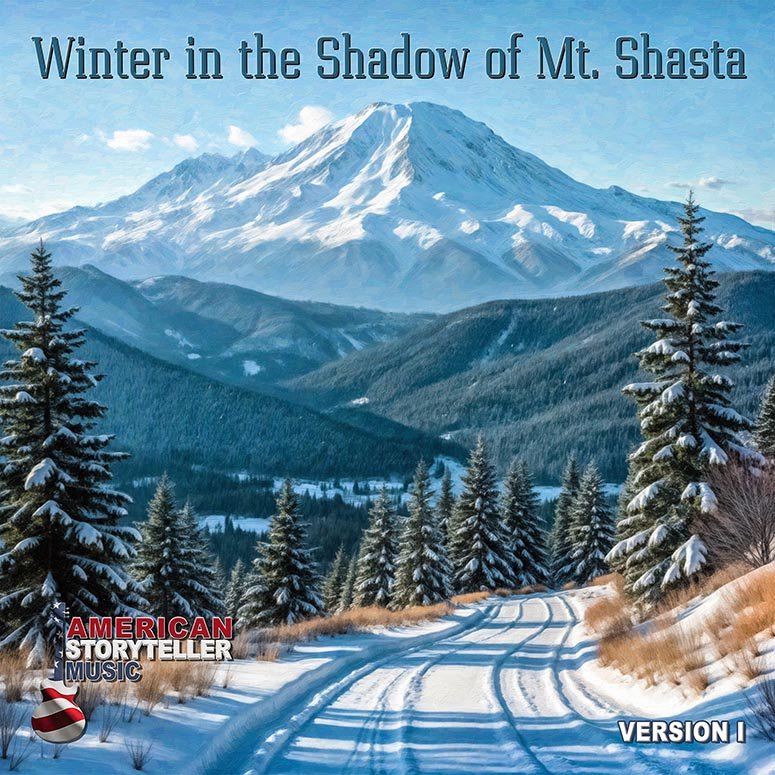
"Winter in The Shadow of Mount Shasta©"
Lyrics by M. S. McKenzie (Unless Otherwise Noted) | Music Performed by Songs Across America or American Storyteller Music, All Songs Are Protected by Copyright
~ Associated State Links ~
"Winter in The Shadow of Mount Shasta"
I wrote "Winter in the Shadow of Mount Shasta" for the specific loneliness of grief that arrives during the one season built for togetherness. Lights are strung like fragmented dreams, all is calm but nothing's what it seems, shattered glass ornaments clutter the floor, and I wanted the holiday imagery to feel hollow rather than comforting, because sometimes the hardest winters are the ones happening right alongside everyone else's celebration.
The story behind the song is how honestly I let the mountain refuse to fix anything. Mountain stands silent to my desperate plea is not a landscape offering healing the way so many of my other songs do. Here the beauty of Shasta sits right alongside real pain, and even surrounded by the beauty of this northern town, I can't relieve my sorrow, because I wanted to be truthful that scenery alone doesn't cure grief, no matter how magnificent it is.
What I care about most is the very last line I could give this narrator, some say spring will come, but I don't know, I'm learning how to live here in the snow. I didn't want a false, tidy recovery. I wanted something more honest, a person who can't promise the pain will lift on schedule, but who is nonetheless finding a way to keep living inside it. Songs Across America has room for songs about landscapes that heal, and this one is for the harder, more real in-between, when healing hasn't arrived yet but living continues anyway.
Somber, atmospheric folk ballad built on sparse instrumentation and a heavy, aching chorus, structured around a single frozen season of grief beneath Mount Shasta.
Grief and heartbreak during winter isolation, the hollowness of holiday imagery amid real pain, a landscape that doesn't cure sorrow but witnesses it, and honest, unresolved coping rather than false recovery.
Primary Subject:
A person enduring a lonely, grief-stricken winter in the shadow of Mount Shasta, surrounded by holiday imagery that offers no comfort.
Mood:
Desolate, aching, and heavy throughout, closing on quiet, unresolved endurance rather than resolution.
Grief doesn't always resolve on a schedule, and sometimes the most honest hope available isn't a promise that the pain will lift, but the quieter, harder commitment to keep learning how to live inside it until it does.
[Verse 1]
Snow is falling like my hopes crashing down
Empty beer bottles fill the room all around
Mountains whisper to the lost and the broken
Cold winds blow away words left unspoken
[Verse 2]
Lights are strung like fragmented dreams
All is calm but nothing's what it seems
Shattered glass ornaments clutter the floor
My heart's in pieces, I can't feel anymore
[Chorus]
Winter in the shadow of Mount Shasta
Freezing cold and lonely pain are my disaster
Long, lonely nights filled with anger and regret
And last year’s ghosts I would rather forget
[Verse 3]
Frosted trees are like ghosts from my past
Every joy in this place never seems to last
Hollow laughter echoes down these empty streets
Any hope I had is buried in snow to my knees
[Bridge]
Shouted promises have been lost to the void
Left out in the cold are feelings we can't avoid
Even surrounded by the beauty of this northern town
Can’t relieve my sorrow as the snow is coming down
[Verse 4]
Time stands frozen like the lake below
Memories trapped beneath the ice and snow
Mountain stands silent to my desperate plea
Another winter claims what's left of me
[Verse 5]
Sun sets early on these mountain days
Casting shadows through this frozen haze
Some say spring will come, but I don't know
I'm learning how to live here in the snow
[Chorus]
Winter in the shadow of Mount Shasta
Freezing cold and lonely pain are my master
Silent nights filled with anger and regret
Last year’s ghosts I would rather forget
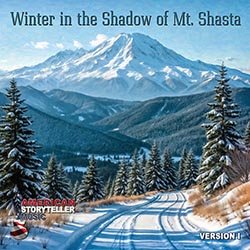
"Winter in the Shadow of Mount Shasta" is a bleak, atmospheric adult contemporary and folk-rock ballad about a person enduring the aftermath of loss during a hard northern California winter. Set beneath the imposing presence of Mount Shasta, the song contrasts extraordinary natural beauty with intense private despair. Snow-covered mountains, frozen lakes, decorated streets, winter trees, and early sunsets surround the narrator, yet none of that beauty can reach him emotionally.
The song is ultimately about the period after something important has broken. A relationship appears to have collapsed, alcohol has become part of the narrator's coping mechanism, anger and regret remain unresolved, and memories of the previous year continue intruding upon the present. The winter landscape becomes an external representation of his emotional condition: cold, immobilized, buried, dark, and difficult to escape.
The title, "Winter in the Shadow of Mount Shasta," immediately establishes both place and mood. Mount Shasta is not simply scenery in the background. Its enormous presence becomes a silent witness to the narrator's suffering.
The word "shadow" is especially important. Literally, the mountain towers over the surrounding region, but emotionally the narrator is living beneath another kind of shadow: the shadow of what happened before the song begins.
That shadow may be the end of a relationship, a betrayal, a period of addiction, grief, or accumulated personal failure. The lyrics deliberately leave the exact history undefined, allowing listeners to recognize their own experiences within the narrator's pain.
Winter intensifies that shadow. Short days, snow, cold, isolation, and long nights all reinforce the feeling that life has narrowed around him.
The first verse opens with snow falling while the narrator's hopes are "crashing down." The contrast is immediately effective. Snow usually falls gently, but his emotional experience is violent.
This opposition between beautiful surroundings and internal collapse becomes one of the song's defining devices. The world outside may appear peaceful, but the narrator experiences no peace.
The empty beer bottles scattered around the room reveal that his suffering has moved beyond private sadness into neglect and unhealthy coping. The bottles are physical evidence of time passing without meaningful recovery.
They also establish that the narrator is isolated indoors while winter continues outside. The room has become a kind of emotional prison.
The line does not romanticize the drinking. The bottles are empty, numerous, and surrounding him. They suggest repetition rather than pleasure.
The mountains whisper to "the lost and the broken," giving the landscape a compassionate voice. Mount Shasta and the surrounding high country seem capable of recognizing people who arrive emotionally damaged.
The mountain does not solve their problems, however. It merely witnesses them.
This is important because the song avoids the simplistic idea that exposure to beautiful scenery automatically heals emotional pain. Nature may provide perspective, but despair can remain present even in magnificent surroundings.
"Cold winds blow away words left unspoken" introduces the failure of communication that may lie behind the narrator's situation.
There were things that should have been said, apologies that may never have been offered, feelings withheld, or final conversations that ended without resolution.
The wind carrying those words away suggests lost opportunity. Once they are gone, they may not be recoverable.
The second verse introduces holiday imagery, but nearly every symbol of celebration has been broken.
Lights are strung like "fragmented dreams." Christmas or winter lights normally suggest warmth, continuity, and hope, yet the narrator sees them as pieces of something that no longer forms a complete picture.
"All is calm but nothing's what it seems" deliberately echoes the peaceful imagery associated with traditional holiday music while overturning it.
The town may appear tranquil beneath snow and lights, but the narrator's interior world is chaotic.
This contrast makes the song particularly effective as a winter piece. It recognizes that the holiday season can intensify loneliness because public expectations of happiness may clash violently with private experience.
The shattered glass ornaments on the floor create one of the strongest visual images in the song.
An ornament is fragile, decorative, and associated with memory. Breaking one can feel strangely significant because it may have belonged to a particular Christmas, person, or family tradition.
A floor covered with shattered ornaments therefore suggests more than an accident. It represents a celebration that has collapsed.
The narrator then says his heart is "in pieces," directly linking the broken glass with emotional fragmentation.
"I can't feel anymore" suggests numbness after prolonged distress. The pain has not necessarily disappeared. It has become so constant that the narrator can no longer distinguish individual emotions.
The chorus gives the song its central image:
"Winter in the shadow of Mount Shasta."
The mountain becomes the fixed landmark beneath which the narrator's emotional disaster unfolds.
The phrase has a cinematic quality. One can imagine the snow-covered summit towering above a small northern California town while the narrator sits alone somewhere below.
"Freezing cold and lonely pain are my disaster" combines external weather and internal suffering. Cold is no longer simply a temperature. It becomes emotional isolation.
The later chorus changes "my disaster" to "my master," and that is a very effective development. At first, the pain is something happening to him. By the end, it has begun controlling him.
The long nights are filled with anger and regret, two emotions that often reinforce one another.
Anger looks outward toward what another person did, while regret looks inward toward what the narrator himself might have done differently.
The combination traps him between blame and self-reproach.
"Last year's ghosts I would rather forget" introduces memory as haunting. These ghosts do not need to be supernatural. They are old arguments, failed promises, photographs, places, anniversaries, and remembered versions of people who no longer exist in the same relationship.
The reference to "last year" is especially effective because it makes the pain recent enough to remain vivid while showing that the narrator has carried it across seasons.
The third verse brings the narrator outside, but the landscape does not provide relief.
Frosted trees become ghosts from the past. Their pale branches resemble figures or memories standing motionless around him.
Once again, winter transforms ordinary beauty into something threatening or mournful because of the narrator's state of mind.
"Every joy in this place never seems to last" suggests that the location itself has become associated with repeated disappointment.
Perhaps the town contains memories of the relationship. Places that once felt comforting now serve as reminders of what was lost.
The hollow laughter echoing through empty streets may belong to distant people, memories, or the narrator's imagination.
The word "hollow" implies that even happiness sounds empty to him.
He hears laughter but cannot participate in it.
The snow burying his hope to his knees is a strong physical metaphor. Hope is not merely gone. It has been covered over.
Snow accumulates gradually, just as grief and disappointment can build through repeated events.
Being knee-deep also suggests difficulty moving. Every step requires effort.
The narrator is not completely immobilized, but progress has become exhausting.
The bridge reveals more directly that the relationship involved conflict.
"Shouted promises have been lost to the void" combines anger and failed commitment.
Promises were not whispered gently. They were shouted, perhaps during arguments, desperate attempts at reconciliation, or moments when both people wanted to be believed.
Now those promises have disappeared into emptiness.
"Left out in the cold are feelings we can't avoid" extends the winter metaphor into emotional abandonment.
Feelings can be suppressed or ignored, but they do not vanish simply because neither person wants to confront them.
The phrase "we can't avoid" also shifts briefly from "I" to "we," reminding the listener that another person remains part of this emotional history.
The narrator is not suffering in a vacuum. Whatever happened affected both people.
The bridge's final lines are especially important:
"Even surrounded by the beauty of this northern town
Can't relieve my sorrow as the snow is coming down."
This is the song's clearest rejection of scenic escapism.
Mount Shasta and the surrounding winter landscape may be breathtaking, but beauty alone cannot repair psychological pain.
The line makes the setting more believable because it avoids treating nature as an automatic cure.
Sometimes a person can stand in one of the most beautiful places imaginable and still feel nothing but grief.
The fourth verse deepens the feeling of emotional paralysis.
"Time stands frozen like the lake below" turns winter into suspended time.
The narrator feels that his life has stopped progressing. Days continue passing, but emotionally he remains trapped at the moment of loss.
The frozen lake becomes a particularly effective metaphor because water normally represents movement.
Once frozen, that movement becomes hidden beneath a hard surface.
The narrator's memories are similarly "trapped beneath the ice and snow."
They remain present but inaccessible, preserved rather than resolved.
The image suggests that forgetting has not occurred. The memories have simply been buried.
When warmer conditions eventually arrive, those memories may resurface.
The mountain remains silent despite the narrator's desperate plea.
Earlier, the mountains whispered to the lost and broken. Now Mount Shasta offers no answer.
This silence marks an important progression.
The narrator may have hoped that nature would reveal some meaning or direction, but the mountain does not speak on command.
Its silence can feel cruel, but it may also represent reality. The landscape cannot make decisions for him.
"Another winter claims what's left of me" brings the verse to its darkest point.
Winter becomes almost predatory, taking away the remaining parts of the narrator's emotional strength.
The phrase suggests depletion. He has already lost much, and now fears losing whatever remains.
The fifth verse introduces the first genuine change in the song.
The sun still sets early, and the frozen haze remains, but the narrator begins thinking about spring.
Importantly, he does not yet believe in it.
"Some say spring will come, but I don't know" is much stronger than a conventional hopeful declaration.
He has heard that circumstances change. Other people may reassure him that pain passes and life eventually returns.
He is not capable of accepting that promise yet.
This makes the hope psychologically credible.
The narrator does not suddenly become optimistic because the song needs an uplifting ending.
Instead, he reaches a smaller and more realistic realization:
"I'm learning how to live here in the snow."
This is arguably the song's most important line.
He is not claiming that the winter has ended.
He is learning to survive inside it.
That distinction gives the song maturity.
Recovery does not always begin with feeling better. Sometimes it begins with functioning despite not feeling better.
"Living in the snow" becomes a metaphor for adapting to grief rather than defeating it.
He learns how to move through the cold, carry the memories, endure the long nights, and continue without certainty that spring is near.
The final chorus changes "my disaster" to "my master."
That alteration darkens the ending, but it also makes the song emotionally interesting.
The narrator recognizes the extent to which loneliness and pain still control him.
Recognition can be the first step toward change.
He has not escaped the winter, but by verse five he has begun observing his own condition rather than simply drowning in it.
The "silent nights" of the final chorus replace the earlier "long, lonely nights," making the ending feel more subdued.
The anger remains, but the emotional volume has lowered.
The ghosts remain unwanted, yet the narrator is beginning to coexist with them.
Musically, "Winter in the Shadow of Mount Shasta" would work especially well as a dark adult contemporary ballad, slow folk-rock song, atmospheric Americana piece, or piano-driven soft-rock track.
The instrumental introduction should immediately establish coldness and isolation.
Sparse piano would be particularly effective, perhaps accompanied by distant cello, low strings, or clean electric guitar with substantial space between notes.
The opening should not be overly lush. Empty space is part of the song's atmosphere.
The first verse could begin almost entirely with piano and voice.
A low bass line could enter beneath the beer-bottle imagery, while restrained percussion gradually appears as the narrator's emotional condition becomes clearer.
The second verse could introduce subtle bells or high piano notes around the holiday lights, but they should sound slightly distant or detuned rather than cheerful.
The shattered ornaments could be accompanied by a brief high-register piano or percussion accent, though literal breaking-glass effects would probably be unnecessary.
The chorus should widen through drums, strings, and sustained guitar.
The title phrase "Winter in the shadow of Mount Shasta" deserves a long melodic line that emphasizes both scale and loneliness.
The melody might rise on "Mount Shasta" and then descend through the lines about disaster, anger, and regret.
That musical descent would mirror the emotional fall.
The third verse could use atmospheric guitar and low strings to evoke ghostlike trees and empty streets.
Backing vocals could appear very faintly behind "hollow laughter," creating an echo without becoming theatrical.
The bridge should intensify the arrangement.
The phrase "shouted promises" could bring stronger drums or distorted guitar, reflecting remembered conflict.
Then the instrumentation could drop back abruptly beneath "Even surrounded by the beauty of this northern town," allowing the resignation in that line to stand clearly.
The fourth verse should be the emotional low point.
The music could become extremely sparse around the frozen lake and silent mountain, perhaps leaving only piano, cello, and vocal.
A long pause after "desperate plea" would reinforce the mountain's silence.
The fifth verse should introduce subtle musical warmth without becoming overtly optimistic.
A slightly brighter chord, acoustic guitar, or higher string line could enter when spring is mentioned.
The shift should be barely perceptible, because the narrator himself remains uncertain.
"I'm learning how to live here in the snow" could be delivered with minimal accompaniment and no dramatic vocal flourish.
Its strength lies in understatement.
The final chorus should be fuller but emotionally restrained.
The change to "pain are my master" should receive emphasis, perhaps through a darker harmony or lower backing vocal.
The song could end without a large resolution.
An instrumental outro might return to the piano figure from the introduction while cello or clean guitar sustains the melody.
The final chord could remain slightly unresolved, reflecting the fact that the narrator is surviving rather than healed.
At its heart, "Winter in the Shadow of Mount Shasta" is a song about grief that refuses easy solutions.
Its narrator drinks, remembers, regrets, becomes angry, feels numb, and searches the landscape for something capable of relieving his pain.
Nothing immediately does.
The mountain remains beautiful but silent.
The snow keeps falling.
The memories remain beneath the ice.
That refusal to manufacture a sudden recovery is one of the song's strongest qualities.
The narrator's progress is much smaller and more believable.
By the end, he has not reached spring.
He has learned how to live through winter.
The song also uses its northern California setting effectively because Mount Shasta provides enormous visual scale against an intensely private story.
The mountain represents endurance, permanence, isolation, and perhaps indifference.
Human relationships can collapse within days or months, while the mountain continues standing above everything.
That contrast can be painful, but it can eventually become reassuring.
The narrator may feel destroyed by one winter, yet the landscape demonstrates that time continues beyond his immediate experience.
The song's repeated imagery of ice, snow, broken glass, ghosts, and frozen water creates a consistent emotional vocabulary.
Everything is either shattered, buried, cold, or suspended.
Only in the final verse does movement begin to return.
The narrator starts learning.
That word matters because learning implies process.
He may fail, relapse into memory, drink again, become angry again, or doubt spring again.
But he is no longer entirely frozen.
"Winter in the Shadow of Mount Shasta" is therefore both a breakup ballad and a portrait of emotional survival.
It does not claim that beautiful surroundings erase suffering, nor does it promise that grief disappears on schedule.
Its deepest message is quieter: when spring feels impossible, survival may begin by learning how to live inside the season you are actually in.
The narrator cannot yet leave the snow behind.
But by the final verse, he has started figuring out how to walk through it.



















.jpg)