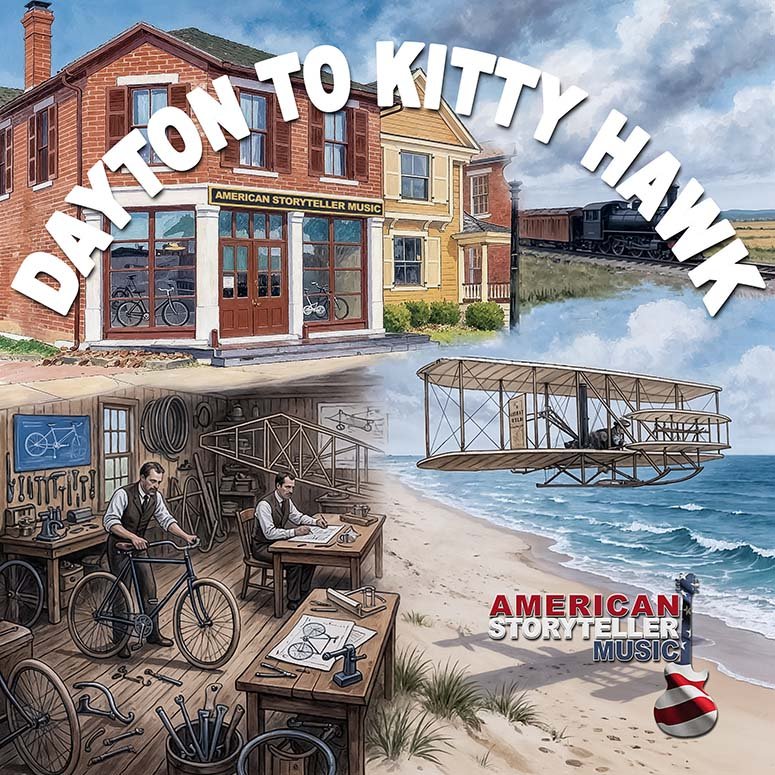
"Dayton to Kitty Hawk©"
Release Date: May 29th, 2026
Lyrics by M. S. McKenzie | Performed by Songs Across America, Protected by Copyright
~ Associated State Links ~
"Dayton to Kitty Hawk"
I wrote "Dayton to Kitty Hawk" to honor the sheer, stubborn ordinariness of how the Wright brothers actually pulled off flight, in a bicycle shop, with bicycle chains and gears, sketching wings on a windowpane rather than in some grand laboratory. Nobody knew how far they had come with elbow grease that was second to none felt like the right way to describe genius that looked, from the outside, like two brothers just tinkering stubbornly with broken frames.
The story behind the song is the pre-chorus, every failure taught them something new, every broken frame made the vision more true, because I wanted the song to honor the failures as much as the eventual flight. Dayton's workshop light and Kitty Hawk's wild Atlantic wind are two very different settings, but I wanted the song to make clear that the real invention happened in the failing, gear by gear, long before the actual flight at the coast.
What I care about most is the chorus's insistence, two Wrights changed the world with more than just talk, because I think that's the whole lesson worth passing down. Songs Across America has room for the country's great inventors, and this one is for the version of genius that looks, most days, like nothing more than persistent, unglamorous elbow grease.
Uplifting, cinematic Americana anthem built on a rising, triumphant chorus, structured as a journey from Dayton's workshop to Kitty Hawk's dunes.
Perseverance through repeated failure, the ordinariness of great invention, the Wright brothers' partnership and stubborn hope, and dreams made real through elbow grease rather than grand pronouncement.
Primary Subject:
Orville and Wilbur Wright, their bicycle shop origins in Dayton, Ohio, and their historic first flight at Kitty Hawk, North Carolina.
Mood:
Determined and hopeful throughout, building to triumphant, historic joy.
Genius often looks like nothing more than persistent, unglamorous effort, failure after failure, until an ordinary bicycle shop dream becomes something that changes the world.
[Instrumental Intro]
[Verse 1]
Back in Dayton by their workshop light
Brothers chased a dream through the night
Hands on the gears and the bicycle chains
Sketching out wings on the windowpane
Streetcar bells and factory smoke
Both brother and partner with a stubborn hope
Nobody knew how far they had come
With elbow grease that was second to none
[Pre-Chorus]
Every failure taught them something new
Every broken frame made the vision more true
They could see the wheels turning in their mind
Like an elusive wind no one else could find
[Chorus]
From the city of Dayton to Kitty Hawk
From a backroom dream to the edge of dawn
With hands full of steel and eyes on the sky
They built their wings and learned to fly
Through searing doubt and drifting clouds
Out where the wild Atlantic screams aloud
Two Wrights changed the world
…with more than just talk
From the city of Dayton to Kitty Hawk
[Verse 2]
Then the Carolina shoreline called
Where the long dunes leaned and the seabirds hauled
Cold salt air and a hard blue sea
Miles of sand and possibility
Canvas trembling in the morning breeze
Footprints running through the Outer Banks trees
Out where the ocean met the sky
They gave that dream one more try
[Pre-Chorus]
Wind in the canvas, sand in the teeth
Holding on to what they still believed
On that lonely strip of wind-blown ground
The future made its first small sound
[Chorus]
From the city of Dayton to Kitty Hawk
From a backroom dream to the edge of dawn
With hands full of steel and eyes on the sky
They built their wings and learned to fly
Through searing doubt and drifting clouds
Out where the wild Atlantic screams aloud
Two Wrights changed the world
…with more than just talk
From the city of Dayton to Kitty Hawk
[Bridge]
Not with thunder
Not with flame
But board by board
And frame by frame
A few brief seconds
A lift, and a steady glide
Then nothing on earth
…was the same
After that famous ride
[Final Chorus]
From the city of Dayton to Kitty Hawk
From a backroom dream to the edge of dawn
With hands full of steel and eyes on the sky
They built their wings and learned to fly
Through searing doubt and drifting clouds
Out where the wild Atlantic screams aloud
Two Wrights changed the world
…with more than just talk
From the city of Dayton to Kitty Hawk
[Outro: Instrumental]
"Dayton to Kitty Hawk" is a sweeping historical tribute to the Wright brothers that turns one of America's most important technological breakthroughs into something deeply human, intimate, and inspiring. Rather than treating flight as a distant, textbook achievement, the song brings it back down to earth and shows it for what it really was at the beginning: a hard-won dream shaped by patience, grit, trial and error, and two determined men willing to keep working when the rest of the world either doubted them or had not yet noticed what they were doing.
At its heart, the song is about the journey from imagination to reality. It begins not in triumph, but in labor: the workshop in Dayton, Ohio, where Wilbur and Orville Wright are shown not as untouchable legends, but as practical inventors immersed in gears, bicycle chains, sketches, smoke, and long nights of experimentation. That grounding is important. The song emphasizes that their genius was not magical or sudden. It was mechanical, disciplined, persistent, and built with working hands. The imagery of "elbow grease" and broken frames reinforces the idea that innovation is often born through repeated failure, not instant success. In that sense, the song honors not just the Wright brothers themselves, but the entire spirit of American invention: modest beginnings, relentless effort, and faith in an idea before the rest of the world can see it.
The chorus gives the song its emotional and geographic spine. "From the city of Dayton to Kitty Hawk" becomes more than a simple travel line. It symbolizes the movement from enclosed workshop to open horizon, from theory to proof, from industrial America to the raw natural forces of the Outer Banks. Dayton represents design, discipline, and the mechanical mind. Kitty Hawk represents testing, risk, and the leap into the unknown. The song beautifully frames those two places as essential partners in the birth of aviation. One gave the dream shape, and the other gave it wind.
Verse two expands the world of the song with vivid coastal imagery. The Carolina shoreline, the dunes, the salt air, the trembling canvas, and the hard blue sea all create a sense of exposure and uncertainty. This is no polished laboratory. It is a wild edge-of-the-world setting where nature itself becomes part of the experiment. The Outer Banks are portrayed almost like a proving ground between earth and sky, the perfect place for history to change. The line about "miles of sand and possibility" is especially powerful because it captures the central tension of the song: the environment is harsh and unforgiving, yet full of promise. The dream survives there because the brothers do.
One of the most effective things the song does is highlight the contrast between the scale of the moment and the humility of how it happened. The bridge captures this perfectly: "Not with thunder / Not with flame / But board by board / And frame by frame." That may be the emotional core of the entire piece. The first powered flight did not arrive with spectacle or grand ceremony. It came through craftsmanship, incremental progress, and quiet determination. The song understands that history often changes not through loud heroic display, but through steady work that only later reveals its world-shaking significance. The "few brief seconds" of flight become the hinge between two eras of human civilization.
There is also an understated poetic brilliance in the repeated line that the Wright brothers changed the world "with more than just talk." That lyric speaks to the difference between dreaming and doing. Plenty of people imagine. Fewer commit themselves to the long process of building something real. The song celebrates action, follow-through, and practical vision. It honors the kind of people who do not just speak of possibility, but bring it into existence with their own hands.
Musically and emotionally, this feels like a song of uplift, perseverance, and quiet grandeur. It likely carries a strong forward motion, fitting for a subject about invention and ascent, but it also seems designed to preserve a sense of humility and reverence. It is not merely a patriotic song, though it certainly carries an American spirit. It is more universal than that. It is about what human beings can do when curiosity, discipline, and courage come together.
Overall, "Dayton to Kitty Hawk" is a stirring and respectful portrait of the birth of flight. It captures the Wright brothers not as distant icons, but as hardworking visionaries whose achievement grew out of failure, faith, and persistence. The song honors both the physical journey from Ohio to the Outer Banks and the larger human journey from earthbound limitation to possibility without end. In doing so, it becomes not just a song about aviation history, but a song about invention itself, and about the moment when a dream finally rose into the air and changed the modern world forever.










.jpg)