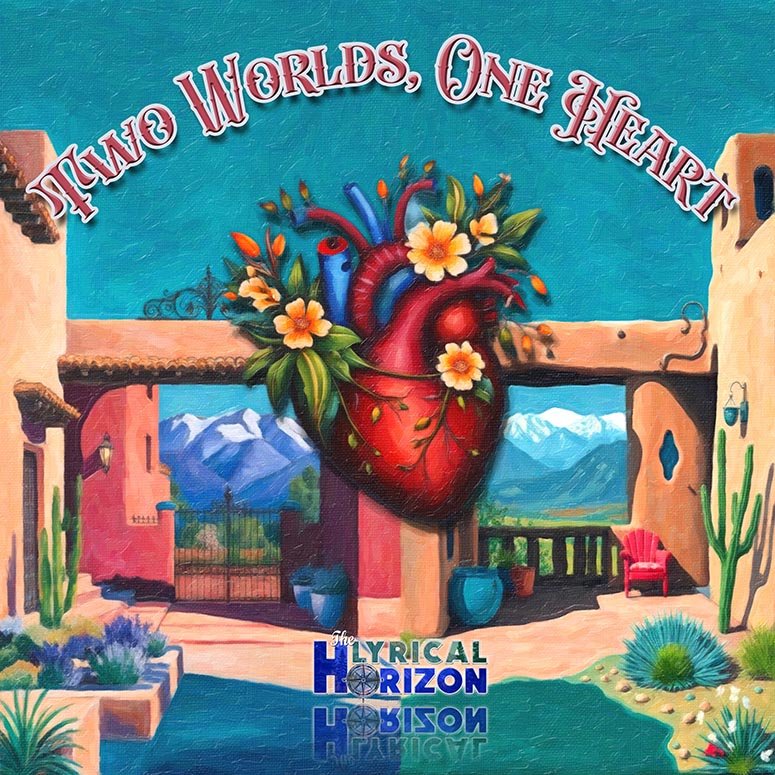
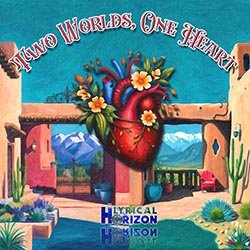
"Two Worlds, One Heart©"
Lyrics by M. S. McKenzie (Unless Otherwise Noted) | Music Performed by Songs Across America or American Storyteller Music, All Songs Are Protected by Copyright
~ Associated State Links ~
I wrote "Two Worlds, One Heart" for a love that crosses a class line most families would rather keep intact, a young woman escaping her family's gilded cage to watch the sunset paint Taos beside a painter whose hands held a million dreams and whose spirit simply couldn't be bought. I wanted the contrast between her world and his to be real, not decorative, because the song only works if the divide is genuinely something her family is trying to protect.
The story behind the song is how much I let New Mexico's actual landscape officiate the relationship, Ghost Ranch and O'Keeffe's colors, Bandelier's canyon light, Chimayó's sunrise, the Rio Grande carving through stone. I wanted the land itself to be doing the work her family wouldn't, blessing a union that the plaza's judging eyes in Albuquerque refuse to. This magical place has stitched our souls into one heart is a claim the desert makes, not a promise the two of them can make to each other alone.
What I care about most is the phrase her frozen heart melts away, because I wanted her transformation to be the real subject, not just the romance itself. She isn't simply falling in love. She's thawing out of a life that had frozen her long before she ever stood beneath that moonless Vallecito sky. Songs Across America has plenty of songs about love overcoming obstacles. This one is about a specific place, New Mexico's own light and stone, being the thing that finally makes that overcoming possible.
Romantic, cinematic Americana ballad built on a soaring, defiant chorus, structured around New Mexico's high desert landmarks as witnesses to a forbidden love.
Forbidden love across class lines, New Mexico's landscape as sanctuary and blessing, family disapproval and gilded confinement, and personal thawing found through both love and place.
Primary Subject:
A young woman from a wealthy family and the painter she loves, defying her family's disapproval amid New Mexico's desert landscape.
Mood:
Romantic, defiant, and tenderly transformative throughout.
Some love stories aren't just about two people overcoming a divide between them, they're about a place patient and beautiful enough to thaw a heart that had frozen long before the love ever arrived.
"Two Worlds, One Heart"
[Verse 1:]
Beneath the Sangre de Cristo's lonely gaze
Your canvas catches the desert light
While I escaped my family's gilded cage
To watch the sunset paint Taos right
Your painter's hands held a million dreams
Your spirit was something I couldn't buy
Your eyes held the vault of stars, it seemed
Beneath that moonless Vallecito sky
[Pre-Chorus:]
They say our worlds should never meet
Like fresh water flowing into the salty sea
But here between these ancient peaks
You've set my captured spirit free
[Chorus:]
Meet me where the Rio Grande carves through the stone
Where piñon pines speak secrets, we've always known
Though my folks try to keep our two worlds apart
This magical place has stitched our souls into one heart
[Verse 2:]
Ghost Ranch whispers held our vows
As O'Keeffe's colors painted the day
Your pickup truck with its rattling sounds
Pulled up loudly to my San Acacio gate
The plaza lights shone Albuquerque bright
As families watched with judging eyes
We danced beneath the canyon light
Where Bandelier captures native skies
[Pre-Chorus:]
They say our love will fade like the rain
In this enchanted desert land
But with each and every Chimayó sunrise
I feel your artist's heart expand
…as my frozen heart melts away
[Chorus:]
Meet me where the Rio Grande carves through the stone
Where piñon pines speak secrets, we've always known
Though my folks try to keep our two worlds apart
This magical place has stitched our souls into one heart
[Verse 3:]
Black Rock's Hot Springs eased our fears
As the steam rose up into the desert night
Your gentle touch captured all my tears
Turned them all to stars with desert light
The grand hacienda where I was raised
So very different from your Pueblo dreams
But when our worlds fade in to the haze
We find the truth of what true love means
[Bridge:]
From Tucumcari to Tent Rocks' silent towers
Our footprints merge like cultures in our lands
Manby Hot Springs' ancient, healing powers
Just like your touch against my trembling hands
My family’s fortune built on oil and on gold
Can't match the riches of your artist's soul
[Verse 4:]
Your newest paintings of Pueblo Row
Now hang beside my family's name
And so the Sant Fe tabloids told
She painted in colors that couldn't be tamed
From High Road’s village to Cumbres’ train
Our separate paths have joined as one
Like sunset meets the mountain rain
New Mexico's enduring love has won
[Final Chorus:]
Meet me where the Rio Grande carves through the stone
Where piñon pines speak secrets, we've always known
Though my folks try to keep our two worlds apart
This magical place has stitched our souls into one heart
"Two Worlds, One Heart" is a cinematic Southwestern love song about two people from sharply different social and cultural backgrounds who find freedom, understanding, and belonging in one another. Set against the mountains, deserts, pueblos, rivers, hot springs, villages, and artistic traditions of New Mexico, the song follows a woman raised in wealth and privilege who falls in love with a painter whose life is rooted in creativity, simplicity, and a much different understanding of what it means to be rich.
The song is both a romance and a story of personal liberation. The narrator has grown up within a "gilded cage," surrounded by money, expectations, family reputation, and social rules. Her material life may be comfortable, but it has also confined her. The painter possesses far less wealth, yet she represents everything the narrator has been missing: independence, authenticity, imagination, emotional courage, and a life guided by inner purpose rather than public approval.
The title, "Two Worlds, One Heart," expresses the song's central conflict and resolution. The lovers come from two different worlds, but the relationship reveals that class, status, family history, and outward appearances do not determine the depth of human connection. Their lives may have begun far apart, but New Mexico becomes the place where those separate paths meet.
The phrase "one heart" does not suggest that either woman must surrender her identity. Instead, it represents emotional unity. They remain distinct individuals, shaped by different experiences, yet their love creates a shared world broad enough to contain both of them.
The first verse opens beneath the Sangre de Cristo Mountains, whose "lonely gaze" gives the landscape a watchful and contemplative presence. The mountains seem to observe the meeting between the narrator and the painter, standing above a story that feels both personal and timeless.
The painter is introduced through her canvas and her ability to capture desert light. This establishes art as more than her occupation. It is her way of seeing the world. She notices color, shadow, distance, and atmosphere with a sensitivity that immediately attracts the narrator.
The narrator, by contrast, has escaped her family's "gilded cage." The phrase describes privilege as a form of imprisonment. Gold surrounds her, but it does not provide freedom. Her family's wealth has created expectations about whom she should love, how she should behave, and what kind of life she should pursue.
Watching the sunset paint Taos becomes a moment of awakening. The narrator has left behind the artificial world of family status and entered a landscape where beauty cannot be purchased or controlled. The changing colors above Taos belong equally to everyone who is willing to stop and see them.
The painter's hands hold "a million dreams," while her spirit is something the narrator "couldn't buy." This contrast establishes the song's moral distinction between material value and spiritual wealth. The narrator's family may possess oil, gold, property, and influence, but none of those things can create the freedom and creative vitality she sees in the painter.
The image of the painter's eyes holding "the vault of stars" gives her an almost cosmic depth. A vault usually contains treasure, but here the treasure is the night sky itself. The lyric transforms wealth from something stored in banks or inherited through families into something found in wonder, imagination, and emotional openness.
The moonless Vallecito sky intensifies this image. Without moonlight, the stars appear especially bright, creating an intimate setting in which the narrator feels she can see more deeply into the painter's character. The darkness does not conceal her. It reveals her.
The first pre-chorus introduces the social opposition to their relationship. Others insist that their worlds should not meet, comparing them to fresh water flowing into the salty sea. The image suggests that their backgrounds are considered incompatible and that one might be changed or absorbed by the other.
Yet the metaphor also contains a contradiction. Rivers naturally flow toward larger bodies of water. Their meeting is not an error but part of a greater cycle. In this way, the lyric quietly challenges the social rule it describes. Difference does not make union impossible. It can make the meeting more powerful.
Between the ancient peaks, the painter sets the narrator's "captured spirit" free. The landscape becomes a refuge from family surveillance and social judgment. The narrator is not merely falling in love. She is discovering a version of herself that could not emerge inside the life chosen for her.
The chorus brings the lovers to the Rio Grande, where water has carved through stone over enormous spans of time. This becomes a metaphor for their relationship. Persistent love can gradually break through barriers that appear permanent, including family expectations, class divisions, prejudice, fear, and inherited beliefs.
"Meet me where the Rio Grande carves through the stone" sounds both romantic and defiant. It is an invitation to meet in a place beyond the boundaries imposed by their families and communities. The river becomes neutral ground where the lovers can exist without explanation.
The piñon pines "speak secrets" they have always known. These secrets may be truths about their identities, their love, or the lives they want to create. Nature does not tell them something entirely new. It helps them acknowledge what they already understand within themselves.
The family's attempts to keep their worlds apart establish the main external conflict. The opposition appears rooted in wealth, status, culture, and social reputation. The narrator's family sees the painter as someone who does not belong within their carefully controlled world.
New Mexico itself resists that separation. The "magical place" stitches their souls into one heart. Stitching suggests both union and healing. The landscape does not simply provide a scenic background for the romance. It helps repair the narrator's divided sense of self.
The second verse moves through several of New Mexico's artistic and cultural landscapes. Ghost Ranch becomes the setting where the lovers exchange vows. Its cliffs, colors, and open desert spaces create an atmosphere of permanence and creative freedom.
The reference to Georgia O'Keeffe connects the painter's work to New Mexico's celebrated visual-art tradition. O'Keeffe's colors seem to paint the day around them, linking the lovers' private commitment with a broader history of artists who found liberation and inspiration in the region.
The painter's rattling pickup truck provides a grounded and humorous contrast with the narrator's wealthy upbringing. Its loud arrival at the San Acacio gate disrupts the controlled dignity of the family estate. The vehicle becomes an announcement that another kind of life has entered this protected world.
The truck may be old, noisy, and materially unimpressive, but it carries the person who has given the narrator freedom. Its imperfections make it more authentic than the polished symbols of wealth surrounding the hacienda.
The plaza lights and judging families bring the relationship into public view. The lovers are no longer hidden beneath private desert skies. They must now endure gossip, scrutiny, and social pressure.
Their dance beneath the canyon light is therefore an act of courage. Dancing allows them to claim joy despite being watched. Instead of allowing judgment to force them apart, they become more visible together.
The reference to Bandelier introduces a landscape shaped by ancient dwellings, canyon walls, and Pueblo history. The phrase "captures native skies" suggests that the land preserves both cultural memory and the vast natural world above it.
The second pre-chorus acknowledges predictions that their love will disappear like desert rain. Rain in New Mexico can arrive suddenly and vanish quickly, making it an appropriate image for something outsiders consider temporary.
The narrator answers that doubt through the repeated experience of Chimayó sunrises. Each dawn represents renewal. Rather than fading, the painter's heart seems to expand, and the narrator's "frozen heart" begins to melt.
This emotional thaw is important. The narrator has not only been controlled by her family but also emotionally protected and restrained. Wealth may have taught her to conceal vulnerability, maintain appearances, and avoid risk. The relationship gives her permission to feel more openly.
The third verse shifts to Black Rock Hot Springs, where warm water and rising steam create a private place of healing. The springs ease the lovers' fears, suggesting that the relationship still carries uncertainty despite their growing commitment.
The painter's touch transforms the narrator's tears into stars. This image does not mean that pain disappears. Instead, sorrow is recognized, held, and transformed into something meaningful. The painter does not dismiss the narrator's grief. She helps her see beauty and possibility within it.
The grand hacienda of the narrator's childhood represents the world she is leaving behind. It is large, imposing, and socially powerful, but emotionally distant. The painter's "Pueblo dreams" represent a different vision based on art, community, cultural connection, and a more modest form of life.
The contrast between the hacienda and Pueblo dreams should not be reduced simply to rich versus poor. It is a conflict between two value systems. One measures success through inheritance, property, and public standing. The other measures it through creativity, emotional honesty, cultural rootedness, and freedom.
When their separate worlds fade into the desert haze, the lovers reach a deeper truth about love. Their relationship becomes clearest when external categories lose their sharpness. Class, reputation, and family expectations recede, leaving two people who understand and choose each other.
The bridge broadens the journey across New Mexico. Tucumcari, Kasha-Katuwe Tent Rocks, and Manby Hot Springs create a sequence of roads, geological formations, and healing landscapes. Their footprints merge across the state, symbolizing lives that are becoming inseparable through shared experience.
The silent towers of Tent Rocks suggest endurance and strange natural beauty. Formed by erosion, they reinforce the song's recurring idea that time and natural forces can reshape even the hardest material.
Manby Hot Springs continues the motif of healing water. The ancient warmth of the springs mirrors the painter's touch, which calms the narrator's fear and helps her trust the relationship.
The trembling hands show that the narrator's liberation is not effortless. She may be brave enough to leave her prescribed life, but she still carries anxiety, guilt, and uncertainty. The painter's touch does not erase those feelings; it gives her the courage to move through them.
The bridge's final couplet states the song's moral argument directly. The narrator's family fortune was built on oil and gold, traditional symbols of power and material wealth. Yet all of it is spiritually inferior to the artist's soul.
The painter's richness comes from imagination, compassion, courage, and the ability to create beauty. These qualities cannot be inherited, bought, or displayed as social status. They must be lived.
The fourth verse brings the painter's work into the narrator's former social world. Her paintings of Pueblo Row now hang beside the family name, symbolizing a reversal of power. The artist once considered unsuitable has created something the wealthy family cannot ignore.
The paintings do not merely decorate the family's world. They challenge it. By hanging beside the established name, the work places creative achievement next to inherited prestige and asks which has greater lasting value.
The Santa Fe tabloids turn the relationship and artistic success into public spectacle. The family's private conflict becomes a story consumed by society. Yet the line "She painted in colors that couldn't be tamed" suggests that neither the press nor the family can control the painter's identity.
Her colors represent artistic independence and perhaps the relationship itself. They are vivid, unconventional, and impossible to contain within polite expectations.
The final journey from the High Road villages to the Cumbres train expands the romance beyond the early scenes around Taos and the Rio Grande. Their separate paths have now joined across the cultural and geographic breadth of northern New Mexico.
The image of sunset meeting mountain rain provides a natural metaphor for union. These elements remain different, yet when they meet they create unusual light, color, and atmosphere. Their difference is not a weakness. It is what makes the scene beautiful.
"New Mexico's enduring love has won" gives the song a broad, triumphant conclusion. The victory belongs not only to the couple but also to a vision of New Mexico as a place where traditions, cultures, landscapes, and individual lives continually meet and influence one another.
The final chorus returns to the Rio Grande, but its meaning has changed. Earlier, the river was a secret meeting place and a refuge from family interference. By the end, it becomes a symbol of the life they have openly chosen.
Their two worlds have not disappeared, but they no longer control the lovers' future. The relationship has created a third world, one built together through art, travel, courage, and shared experience.
Musically, "Two Worlds, One Heart" would work well as a cinematic Southwestern adult contemporary ballad, folk-rock love song, or melodic country-pop duet. Acoustic guitar, piano, strings, restrained drums, and Southwestern instrumental touches could support the wide desert imagery and emotional storytelling.
A nylon-string guitar, mandolin, violin, or subtle Spanish-style acoustic phrasing could provide regional character without turning the arrangement into a caricature. Warm electric guitar with gentle reverb could suggest open desert space.
The first verse should begin intimately, perhaps with acoustic guitar and piano beneath a single lead vocal. The arrangement can gradually widen as the narrator describes the painter's spirit and the stars above Vallecito.
The pre-chorus should create tension through rising strings or sustained chords. This would reflect the social pressure keeping the lovers apart before the chorus opens into the freedom of the Rio Grande landscape.
The chorus should feel sweeping and romantic, with a strong melodic rise on "Meet me where the Rio Grande carves through the stone." Layered harmonies could enter on "two worlds apart" and "one heart," emphasizing both conflict and resolution.
The second verse could introduce more rhythmic energy as the rattling pickup arrives and the lovers dance beneath the plaza lights. Light percussion, fiddle, or hand drums might add movement without overwhelming the vocal narrative.
The bridge should provide the song's emotional high point. The instrumentation could build beneath the journey from Tucumcari to Tent Rocks before briefly dropping away for the lines about oil, gold, and the riches of the artist's soul.
The final verse and chorus could expand into a full orchestral or folk-rock arrangement, with strings, electric guitar, strong drums, and higher harmony vocals. The music should convey victory, but it should remain warm and heartfelt rather than excessively grand.
A final instrumental passage might return to the melody of the first verse, now played with fuller strings or violin. This would suggest that the love story has changed the meaning of the landscape first seen beneath the Sangre de Cristo Mountains.
At its heart, "Two Worlds, One Heart" is a song about choosing an authentic life over an inherited one. The narrator is not simply rejecting wealth. She is rejecting the idea that money, family reputation, or social expectation should determine whom she loves and who she becomes.
The painter is not valuable because she rescues the narrator in a conventional sense. She helps the narrator recognize her own capacity for freedom. Their relationship succeeds because it allows both women to remain creative, independent, and emotionally honest.
The song also presents art as a force capable of crossing social boundaries. The painter begins as someone dismissed by the narrator's family, but her work ultimately enters their world and claims its own place beside the family name. Artistic worth outlives prejudice and challenges inherited definitions of success.
New Mexico is essential to this transformation. Its rivers carve through stone, its hot springs offer healing, its mountains create refuge, and its artistic landscapes encourage lives that do not conform easily to expectation. The state's physical and cultural complexity mirrors the lovers' ability to create unity without erasing difference.
"Two Worlds, One Heart" is therefore both a sweeping love story and a declaration of personal independence. It celebrates the moment when two people stop allowing other people's definitions of class, culture, success, and belonging to determine the shape of their lives.
The song's final message is that the greatest form of wealth is not inherited fortune but the freedom to love honestly, create fearlessly, and build a shared life rooted in truth. In the vast and changing landscapes of New Mexico, two seemingly incompatible worlds become one enduring heart.









.jpg)